
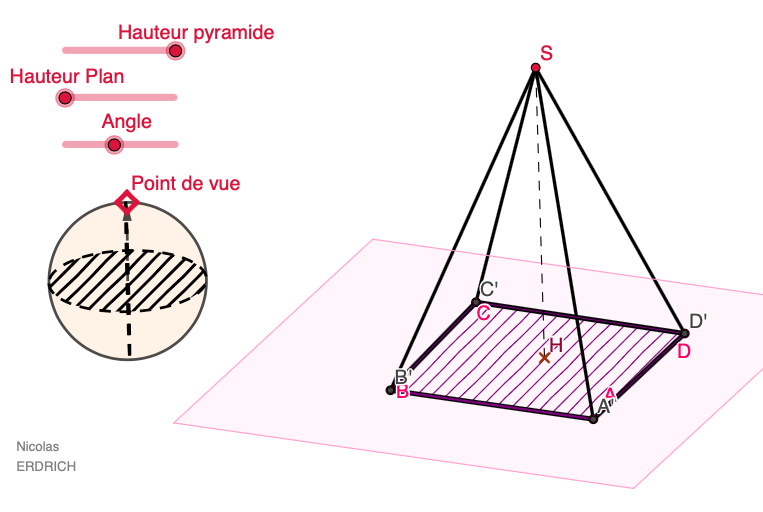
Cross-section of a pyramid: cutting with a plane parallel to the base
Loading the math board and drawing, please wait…
In collections
Area, Surface Area, Volume--Nets
This example demonstrates the cross-section of a pyramid formed by cutting it with a plane parallel to its base. The key mathematical concepts involve solid geometry, derivatives, and area changes, as well as coordinate geometry through plane equations. Construction points include using GeoGebra commands like Circle, PointIn, Vector, Dilate, Polygon, and Conic to create the cross-section, with parametric adjustments for cutting position. Suitable for high school students or college freshmen to learn solid geometry and calculus fundamentals, and for geometric construction practice.
GeoGebra Commands & Parameters
Circle(O, Zoom) → cPointIn(c) → PVector(O, Z) → wVector(O, Y) → vVector(O, X) → uDilate(D_1, 0.6, O') → D'_3Dilate(C_1, 0.6, O') → C'_3Dilate(B_1, 0.6, O') → B'_3Dilate(A_1, 0.6, O') → A'_3Polygon(A'_3, B'_3, C'_3, D'_3) → poly1'_1, a'_3, b'_3, c'_3, d'_3Conic(Y, M_1, X, M_v, M_u) → dConic(Z, X, M_w, M_2, M_u) → eConic(Z, M_3, Y, M_w, M_v) → fPolygon(A_1, B_1, C_1, D_1) → poly1, a, b, c_1, d_1PointIn(poly1'_1) → BPointIn(poly1'_1) → APointIn(poly1'_1) → DPointIn(poly1'_1) → CPolygon(A, B, C, D) → poly2, e_1, h_3, g, f_1Translate(A_1, Vector[(h * u)]) → A'Translate(B_1, Vector[(h * u)]) → B'Translate(C_1, Vector[(h * u)]) → C'Translate(D_1, Vector[(h * u)]) → D'Polygon(A', B', C', D') → poly1', a', b', c', d'PointIn(poly1') → SPolygon(S, A, B) → poly3, h_1, s, e_2Polygon(S, B, C) → poly4, g_1, s_1, h_2Polygon(C, D, S) → poly5, s_2, g_2, f_2Polygon(A, D, S) → poly6, s_3, e_3, f_3Dilate(A, hauteur3, S) → E'Dilate(B, hauteur3, S) → H'_1Dilate(C, hauteur3, S) → G'Dilate(B, h2, S) → H'_2Dilate(D, hauteur3, S) → F'Polygon(E', H'_1, G', F') → poly7, e', h'_1, g', f'Translate(B_1, Vector[(((1 - hauteur3) * h) * u)]) → B'_2Translate(C_1, Vector[(((1 - hauteur3) * h) * u)]) → C'_2Translate(D_1, Vector[(((1 - hauteur3) * h) * u)]) → D'_2Translate(A_1, Vector[(((1 - hauteur3) * h) * u)]) → A'_2Polygon(A'_2, B'_2, C'_2, D'_2) → poly1'', a'_2, b'_2, c'_2, d'_2Dilate(B, hauteur3, S) → H'Dilate(A, hauteur3, S) → E'_1Dilate(C, hauteur3, S) → G'_1Translate(A_1, Vector[((1 - hauteur3) * u)]) → A'_1Translate(B_1, Vector[((1 - hauteur3) * u)]) → B'_1Translate(C_1, Vector[((1 - hauteur3) * u)]) → C'_1Translate(D_1, Vector[((1 - hauteur3) * u)]) → D'_1Translate(S, Vector[((-h) * u)]) → HSegment(H, S) → jVector(O, P) → l
AI Drawing Prompt Reference
Draw a square pyramid with a square base and an apex above. Cut the pyramid with a plane parallel to the base, creating a smaller square cross-section inside, similar to the base. Connect corresponding vertices between the cross-section and the base to form the side faces. Then choose a point above the cross-section as a new apex, and connect it to the cross-section vertices to form a smaller pyramid. Use dashed lines to indicate the cutting plane and label the height ratio. Show the concept of parallel cross-sections and similar shapes in solid geometry.
The prompt above was compiled from the original drawing commands and is for reference only.