
Critical Angle for Total Internal Reflection Demo
Loading the math board and drawing, please wait…
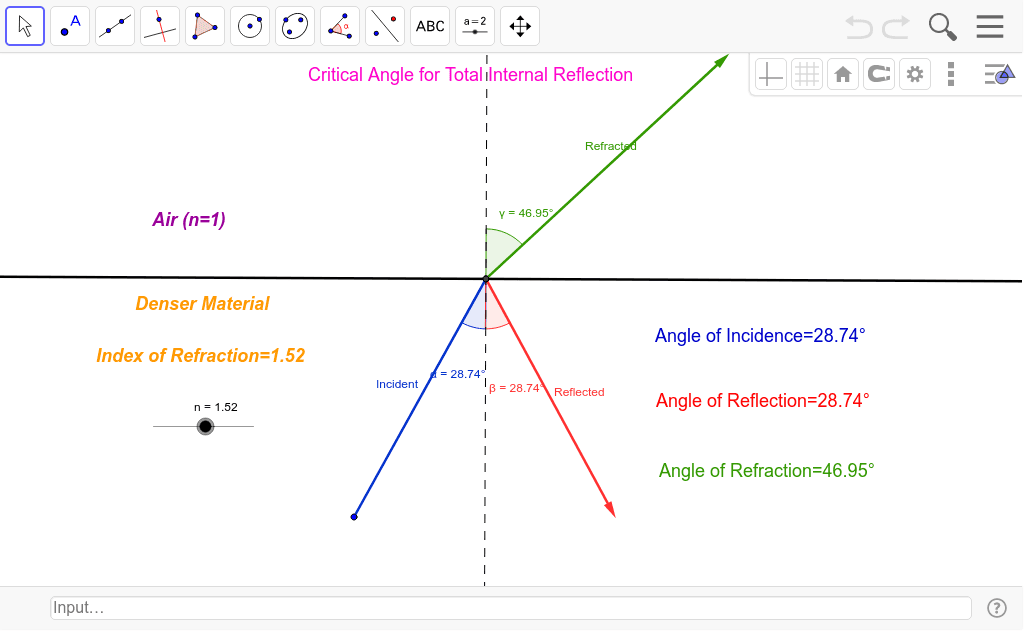
This example demonstrates the relationship between reflected and refracted rays when light travels from a denser medium to air, clearly showing the critical angle phenomenon. It involves core math concepts like angles, geometric reflection law, refraction law, and trigonometric applications. Construction highlights the use of commands/objects such as Segment, Midpoint, OrthogonalLine, Point, Mirror, Angle, Rotate, and Vector in GeoGebra. Suitable for high school physics optics teaching and university basic geometry learning.
GeoGebra Commands & Parameters
Segment(A, B) → aMidpoint(a) → COrthogonalLine(C, a) → bPoint(b) → GPoint(b) → EMirror(C, b) → C'Angle(D, C', E) → αSegment(D, C) → IncidentMirror(D, b) → D'Angle(E, C', D') → βRotate(G, (-asin((n * sin(α)))), C') → G'Angle(G', C', G) → γVector(C', G') → RefractedVector(C', D') → Reflected
AI Drawing Prompt Reference
Draw a diagram demonstrating the critical angle for total internal reflection. Show light rays traveling from a denser medium to air, with one ray for reflection and one for refraction. Label the incident and refracted angles, and clearly indicate the critical angle where the reflected ray aligns with the incident ray. Include a horizontal segment as the medium boundary, a perpendicular line from its midpoint, points on the perpendicular, mirrored points, and connected segments to form the incident ray. Rotate and draw the refracted and reflected rays based on the angle to illustrate the relationship.
The prompt above was compiled from the original drawing commands and is for reference only.