
Corresponding Angles Theorem Proof
Loading the math board and drawing, please wait…
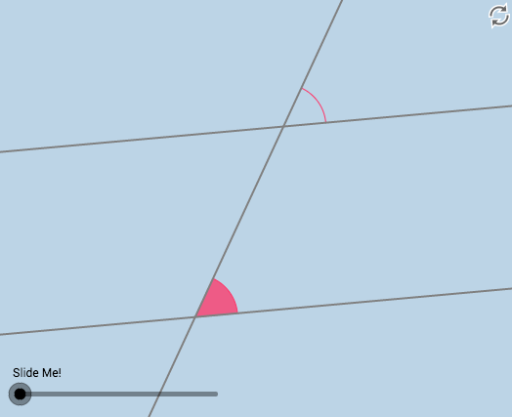
This example demonstrates the Corresponding Angles Theorem, which states that when two parallel lines are cut by a transversal, the corresponding angles are equal. Key mathematical concepts include angle properties and line relationships. Using GeoGebra commands such as Point, Rotate, Angle, and Line, the dynamic changes in angles and the proof process are shown. Suitable for students in middle school and above learning geometric proofs.
GeoGebra Commands & Parameters
Point(a) → BRotate(B, α, A) → B'Angle(B, A, B') → βLine(A, B') → bCircle(A, 1) → eIntersect(b, d) → CCircle(C, 1) → fIntersect(e, a) → D, EIntersect(e, b) → F, GIntersect(f, b) → H, IIntersect(f, d) → J, KCircleSector(C, K, I) → gCircleSector(C, I, J) → hCircleSector(C, J, H) → kCircleSector(C, H, K) → pCircleSector(A, E, G) → qCircleSector(A, G, D) → rCircleSector(A, D, F) → sCircleSector(A, F, E) → tDilate(A, If[0 < i < 1, 1 - i, 0], C) → A'Vector(A, A') → uTranslate(q, u) → q'Translate(r, u) → r'Translate(s, u) → s'Translate(t, u) → t'CircleArc(A, E, G) → c_1CircleArc(C, K, I) → d_1CircleArc(C, I, J) → e_1CircleArc(A, G, D) → f_1CircleArc(A, D, F) → g_1CircleArc(C, J, H) → h_1CircleArc(A, F, E) → k_1CircleArc(C, H, K) → p_1
AI Drawing Prompt Reference
Draw a figure where two parallel lines are intersected by a transversal to demonstrate the Corresponding Angles Theorem. Start by drawing points A and B, then rotate B to get B', draw angle β, and draw line B'B. Next, draw circles A and C, find intersection points C, D, E, F, G, H, I, J, then draw arcs g, h, k, p, q, r, s, t. Finally, use translation and rotation to move the arcs to the correct positions, forming the proof of corresponding angles being equal.
The prompt above was compiled from the original drawing commands and is for reference only.