
Corresponding Angles for Parallel Lines
Loading the math board and drawing, please wait…
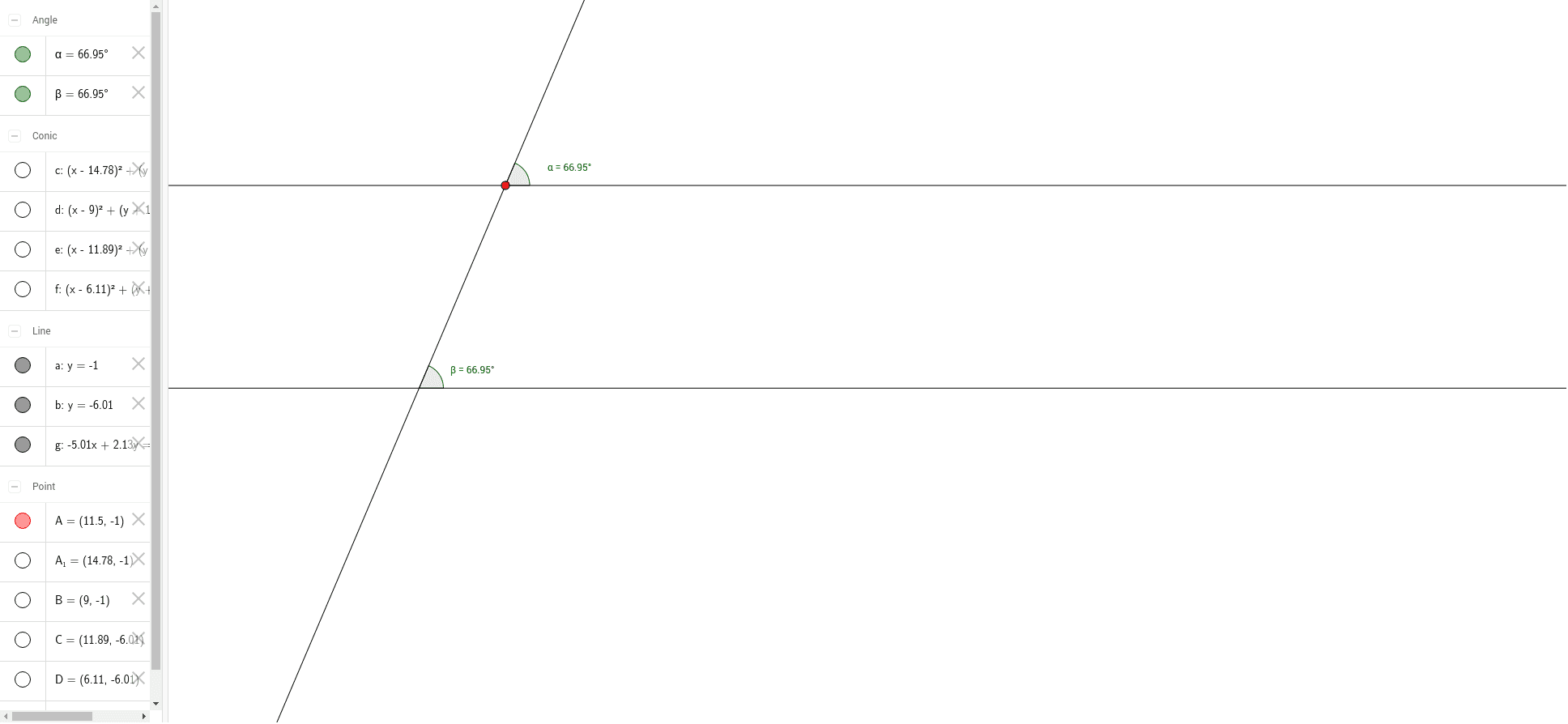
This example demonstrates the construction of corresponding angles formed by parallel lines. Key mathematical concepts include properties of parallel lines, angle equality, and geometric construction techniques. The construction uses GeoGebra commands such as Circle, Intersect, Line, and Angle to create the corresponding angle figure. Suitable for middle school students learning geometry basics or high school students reviewing parallel line theorems.
GeoGebra Commands & Parameters
Circle(A_1, B) → cCircle(B, A_1) → dIntersect(c, d, 1) → CCircle(C, B) → eIntersect(d, e, 2) → DCircle(D, C) → fLine(B, A_1) → aLine(D, C) → bPoint(b) → EPoint(a) → ALine(E, A) → gAngle(a, g) → αAngle(b, g) → β
AI Drawing Prompt Reference
Draw two parallel lines and select a point on one line. Draw circles centered at this point that intersect the parallel lines, obtaining four intersection points. Then, draw circles centered at two of these intersection points that intersect the previous circles, getting two more intersection points. Connect these points to form two lines and measure the corresponding angles formed between these lines and the parallel lines, demonstrating that corresponding angles are equal.
The prompt above was compiled from the original drawing commands and is for reference only.