
Corresponding Angles and Sides of Congruent Triangles
Loading the math board and drawing, please wait…
In collections
CCSS Support Math I Unit 5
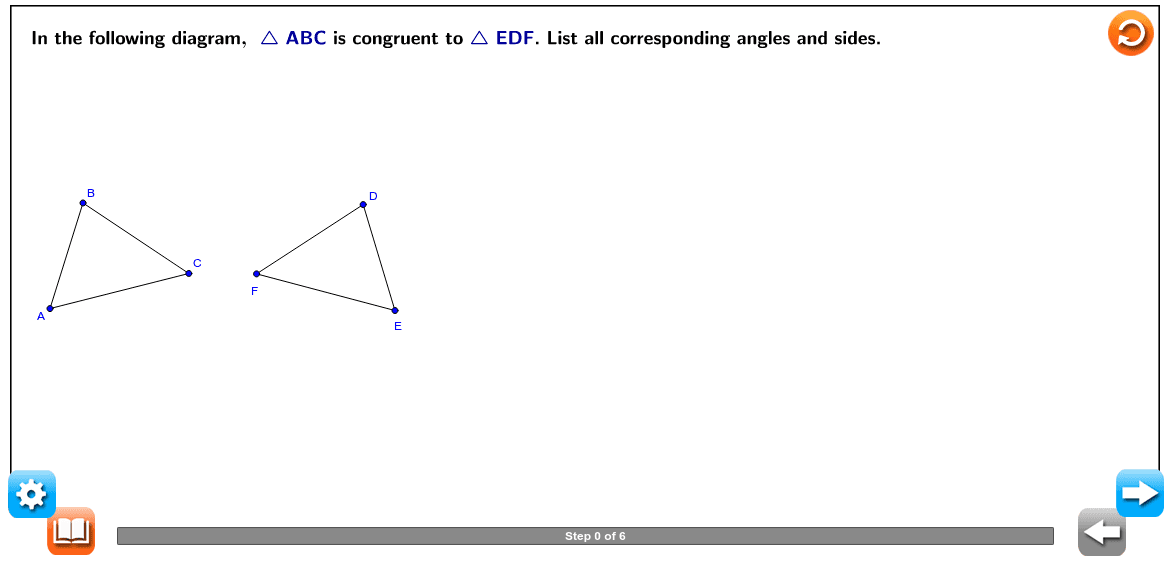
This example demonstrates the corresponding angles and sides of two congruent triangles, ABC and EDF. Key math concepts include triangle congruence criteria and relationships between corresponding parts. Construction involves commands like LaTeX, Segment, Mirror, and objects such as sliders and definitions in GeoGebra. Suitable for middle school and above students learning geometric proofs and spatial reasoning.
GeoGebra Commands & Parameters
LaTeX("\text{Determine the corresponding angles.}") → SubQuestion1LaTeX("\text{Congruent triangles are named so that corresponding parts are}") → step1_1LaTeX("\text{named in the same sequence.}") → step1_2LaTeX("\text{Determine the corresponding sides.}") → step4LaTeX("\text{are named in the same sequence.}") → step5_2LaTeX("\text{\mathbf{Corresponding \;angles} angles of two figures that lie in the same position relative to}") → words1_1LaTeX("\text{\mathbf{Corresponding \;sides} sides of two figures that lie in the same position relative}") → words2_1Segment(A, B) → a_1Segment(B, C) → bSegment(A, C) → cSegment(dummy1, dummy2) → dummyMirror(Border, dummy) → Border'Mirror(A, dummy) → EMirror(Border, dummy) → Border'_1Mirror(B, dummy) → DMirror(C, dummy) → FSegment(F, D) → dSegment(D, E) → eSegment(F, E) → fLaTeX("\text{ the figure.In transformations,the corresponding vertices are the preimage and}") → words1_2LaTeX("\text{ to the figure.In transformations,the corresponding sides are the preimage and}") → words2_2LaTeX("\text{image sides,so \textcolor{#000099}{\(\overline{AB}\)} and \textcolor{#000099}{\(\overline{A'}\) \(\overline{B'}\)} are corresponding sides and so on.}") → words2_3LaTeX("\text{image vertices,so \textcolor{#000099}{∠A} and \textcolor{#000099}{∠A`} are corresponding vertices and so on. }") → words1_3LaTeX("\text{In the following diagram, \textcolor{#000099}{ \triangle ABC} is congruent to \textcolor{#000099}{\triangle EDF}. List all corresponding angles and sides.}") → QuestionLaTeX("\text{For this reason, in \textcolor{#000099}{\triangle ABC} and \textcolor{#000099}{\triangle{EDF}}, \textcolor{#000099}{\angle{A}} corresponds to \textcolor{#000099}{\angle{E},}}") → step2_1LaTeX("\text{\textcolor{#000099}{\angle B} corresponds to \textcolor{#000099}{\angle D}, and \textcolor{#000099}{\angle C} corresponds to \textcolor{#000099}{\angle F}.}") → step2_2LaTeX("\text{Again, congruent triangles are named so that corresponding parts}") → step5_1LaTeX("\text{For this reason, in \textcolor{#000099}{\triangle ABC} and \textcolor{#000099}{\triangle EDF}, \textcolor{#000099}{\(\overline{AB}\)} corresponds to \textcolor{#000099}{ \(\overline{ED}\)},}") → step6_1LaTeX("\text{\textcolor{#000099}{\(\overline{BC}\)} corresponds to \textcolor{#000099}{ \(\overline{DF}\)}, and \textcolor{#000099}{\(\overline{CA}\)} corresponds to \textcolor{#000099}{\(\overline{FE}\)}.}") → step6_2