
Coordinate Geometry to Prove that a Quadrilateral is a Parallelogram
Loading the math board and drawing, please wait…
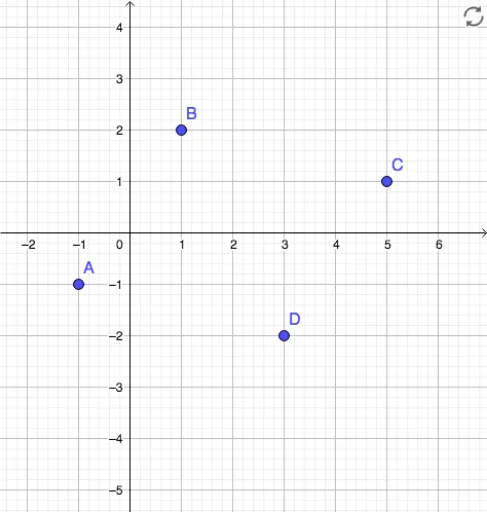
This example demonstrates how to use coordinate geometry to prove that a quadrilateral is a parallelogram by calculating midpoints of diagonals or comparing side slopes. The core mathematical concepts involve coordinates in the Cartesian plane, the distance formula, the midpoint formula, and parallelogram criteria such as diagonals bisecting each other or opposite sides being parallel and equal. The construction uses four free points A, B, C, and D in GeoGebra, with tools to measure coordinates and compute midpoints or slopes. It is suitable for upper middle school or high school students to connect analytic geometry with classical geometry theorems, and can be used as an interactive demonstration where dragging vertices shows how the properties change.
GeoGebra Commands & Parameters
Point A(-1, -1)Point B(1, 2)Point C(5, 1)Point D(3, -2)
AI Drawing Prompt Reference
Draw a quadrilateral on a Cartesian plane with vertices at (-1,-1), (1,2), (5,1), and (3,-2). Connect the vertices to form the shape, then draw both diagonals and mark their midpoints. Also display the slopes of opposite sides so that one can check whether the diagonals bisect each other or the opposite sides are parallel and equal, confirming whether the quadrilateral is a parallelogram.
The prompt above was compiled from the original drawing commands and is for reference only.