
Cooperative Polygons
Loading the math board and drawing, please wait…
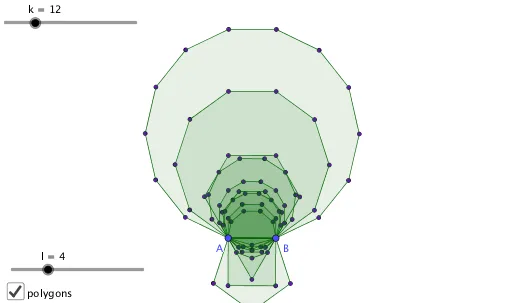
This example demonstrates polygon construction and related attribute changes through dynamic interaction; involves core math concepts like polygons, logarithmic functions, polynomial functions, Poisson distribution, confidence intervals, and statistics; constructed using GeoGebra commands Ray, Intersect, Sequence and objects A, B, n, m, f, g, D, k, l, L_1, L_2, L_3, a; suitable for high school and above mathematics teaching and exploratory learning, integrating geometric construction with data analysis.
GeoGebra Commands & Parameters
Ray(A, Rotate[B, 90° - ((2 * π) * (m + 1) / ((2 * n))), A]) → fRay(B, Rotate[A, (-(90° - ((2 * π) * (m + 1) / ((2 * n))))), B]) → gIntersect(f, g) → DSequence(Rotate[A, ((i * 2) * π / n), D], i, 0, n - 1) → L_1Sequence(polyvxs[A, B, 2 + i, Mod[i, l]], i, 1, k) → L_2Sequence(Polygon[polyvxs[A, B, 2 + i, Mod[i, l]]], i, 1, k) → L_3
AI Drawing Prompt Reference
Draw a polygon with points A and B, generate a series of vertices by rotating, then construct a series of quadratic polynomial curves using these vertices, and finally enclose a series of polygons with these curves. Use sliders to control the number of sides of the polygon and the degree of the polynomial, and observe the changes in the polygon and curves.
The prompt above was compiled from the original drawing commands and is for reference only.