
Converse of Pythagoras' Theorem
Loading the math board and drawing, please wait…
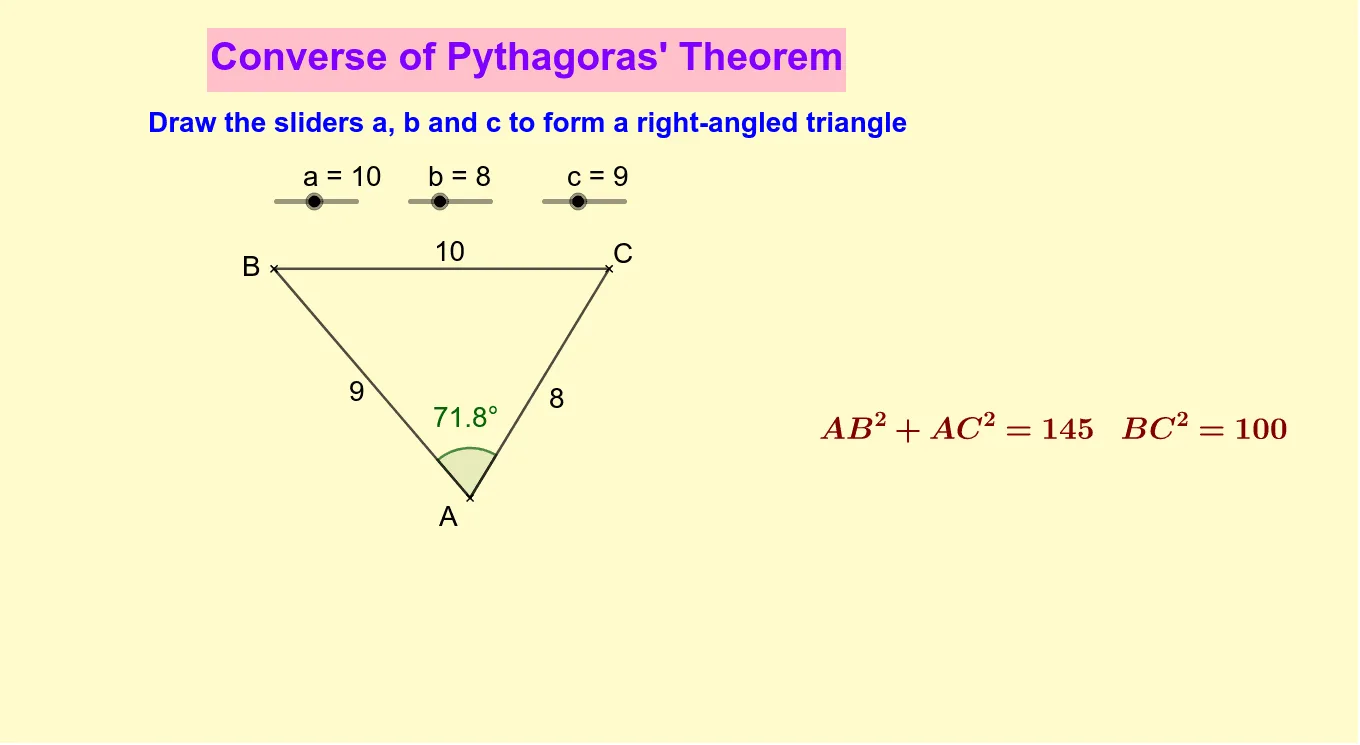
This example demonstrates the converse of Pythagoras' Theorem: if the lengths of the sides of a triangle satisfy a²+b²=c², then the triangle is a right triangle. Key math concepts include Pythagorean Theorem, right triangle congruence, and triangle side relationships. Construction involves GeoGebra commands like Circle, Point, Segment, Intersect, Angle, and Max. Suitable for high school students learning to apply the converse theorem.
GeoGebra Commands & Parameters
Circle(B, a) → dPoint(d) → CCircle(C, b) → eSegment(B, C) → fCircle(B, c) → gIntersect(g, e) → C_1, A, ,Segment(B, A) → hSegment(A, C) → iAngle(C, A, B) → αAngle(A, B, C) → βAngle(B, C, A) → γMax({a, b, c}) → j
AI Drawing Prompt Reference
Draw a triangle with two sides of lengths a and b, and the third side of length c, to demonstrate that if a²+b²=c², the triangle is right-angled. Start by drawing a circle centered at B with radius a, then a circle centered at C with radius b, and mark their intersection as point A. Connect BC and AB, measure the angles α, β, γ, and verify the Pythagorean theorem.
The prompt above was compiled from the original drawing commands and is for reference only.