
Constructing Platonic Solids: Which Polygons Work?
Loading the math board and drawing, please wait…
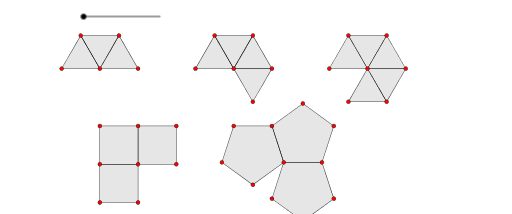
This example demonstrates how different polygons can be used to construct Platonic solids, revealing their geometric properties. It involves core mathematical concepts such as polygons, solid geometry, symmetry, and Euclidean geometry. Key GeoGebra commands and objects used include Polygon, OrthogonalLine, Intersect, Vector, Point, Circle, Segment, Rotate, and Angle. Suitable for high school students and math enthusiasts exploring spatial geometry and polyhedral constructions.
GeoGebra Commands & Parameters
Polygon(A, B, 3) → poly1, f, g, h, CPolygon(C, B, 3) → poly2, i, j, k, DPolygon(D, B, 3) → poly3, l, m, n, EOrthogonalLine(B, k) → pOrthogonalLine(C, j) → qIntersect(p, q) → FVector(G, A) → uVector(G, B) → vVector(G, E) → wVector(G, C) → bVector(G, D) → cVector(G, F) → dPoint(point1) → HPoint(point2) → IPoint(point3) → JPolygon(C, H, D) → poly4, d_1, c_1, h_1Polygon(C, I, H) → poly5, h_2, c_2, i_1Polygon(D, J, H) → poly6, h_3, d_2, j_1Polygon(K, L, 3) → poly7, r, s, t, MPolygon(M, L, 3) → poly8, e, f_1, g_1, NPolygon(N, L, 3) → poly9, k_1, l_1, m_1, OPolygon(O, L, 3) → poly10, n_1, p_1, q_1, PPolygon(N, M, 4) → poly11, r_1, s_1, t_1, a_1, Q, ROrthogonalLine(L, g_1) → b_1OrthogonalLine(M, f_1) → e_1Intersect(b_1, e_1) → SPolygon(M, N, T) → poly12, t_2, m_2, n_2Polygon(M, U, T) → poly13, t_3, m_3, u_1Polygon(T, N, V) → poly14, v_1, t_4, n_3Polygon(T, W, V) → poly15, v_2, t_5, w_1Polygon(Z, A_1, 3) → poly16, f_2, g_2, i_2, B_1Polygon(B_1, A_1, 3) → poly17, j_2, k_2, l_2, C_1Polygon(C_1, A_1, 3) → poly18, p_2, q_2, r_2, D_1Polygon(D_1, A_1, 3) → poly19, s_2, a_2, b_2, E_1Polygon(E_1, A_1, 3) → poly20, e_2, f_3, g_3, F_1Polygon(C_1, B_1, 5) → poly21, i_3, j_3, k_3, l_3, p_3, G_1, H_1, I_1OrthogonalLine(B_1, k_2) → q_3OrthogonalLine(A_1, l_2) → r_3Intersect(r_3, q_3) → J_1Polygon(B_1, C_1, K_1) → poly22, k_4, b_3, c_3Polygon(C_1, L_1, K_1) → poly23, k_5, c_4, l_4Polygon(K_1, L_1, M_1) → poly24, m_4, k_6, l_5Polygon(B_1, O_1, K_1) → poly25, k_7, b_4, o_1Polygon(K_1, N_1, M_1) → poly26, m_5, k_8, n_4Polygon(Z_1, A_2, 5) → poly27, s_3, a_3, d_3, e_3, f_4, B_2, C_2, D_2Polygon(Z_1, D_2, 5) → poly28, g_4, h_4, i_4, j_4, p_4, E_2, F_2, G_2Polygon(E_2, D_2, 5) → poly29, q_4, r_4, s_4, a_4, d_4, H_2, I_2, J_2Circle(U_1, W_1, Q_1) → e_4Circle(U_1, 2) → c_5Intersect(e_4, c_5, 2) → K_2Circle(K_2, 2) → d_5Polygon(K_2, U_1, 6) → poly30, f_5, O_2, g_5, h_5, i_5, j_5, n_5, L_2, M_2, N_2Segment(L_2, R_1) → p_5Segment(R_1, K_2) → q_5Segment(R_1, Q_1) → r_5Polygon(U_2, P_2, R_1, T_2) → poly31, u_2, p_6, r_6, t_6Polygon(P_2, Q_2, R_2, R_1) → poly32, p_7, q_6, r_7, r_8Polygon(Q_1, R_1, T_2, S_2) → poly33, q_7, r_9, t_7, s_5Polygon(E_2, Z_1, 3) → poly34, a_5, b_5, e_5, W_2Rotate(W_2, (-(20°)), E_2) → Z_2Angle(Z_2, E_2, W_2) → αSegment(E_2, Z_2) → f_6Intersect(f_6, b_5) → A_3Rotate(Z_1, 20°, E_2) → B_3Angle(Z_1, E_2, B_3) → βSegment(B_3, E_2) → g_6Intersect(g_6, b_5) → C_3Circle(Z_1, C_3) → c_6Circle(W_2, A_3) → d_6Intersect(c_6, a_5) → D_3,Intersect(d_6, e_5) → E_3,Intersect(c_6, a_5, 1) → F_3Circle(D_3, Z_1) → e_6Circle(E_3, W_2) → h_6Intersect(e_6, a_5) → G_3, H_3Intersect(h_6, e_5) → I_3, J_3OrthogonalLine(Z_1, e_5) → i_6OrthogonalLine(E_2, b_5) → j_6Intersect(i_6, j_6) → K_3Polygon(Z_1, L_3, M_3, E_2, N_3) → poly35, z_1, l_6, m_6, e_7, n_6Polygon(Z_1, T_3, S_3, R_3, N_3) → poly36, z_2, t_8, s_6, r_{10}, n_7Polygon(N_3, E_2, O_3, P_3, Q_3) → poly37, n_8, e_8, o_3, p_8, q_8