
Constructing Cone and Cylinder
Loading the math board and drawing, please wait…
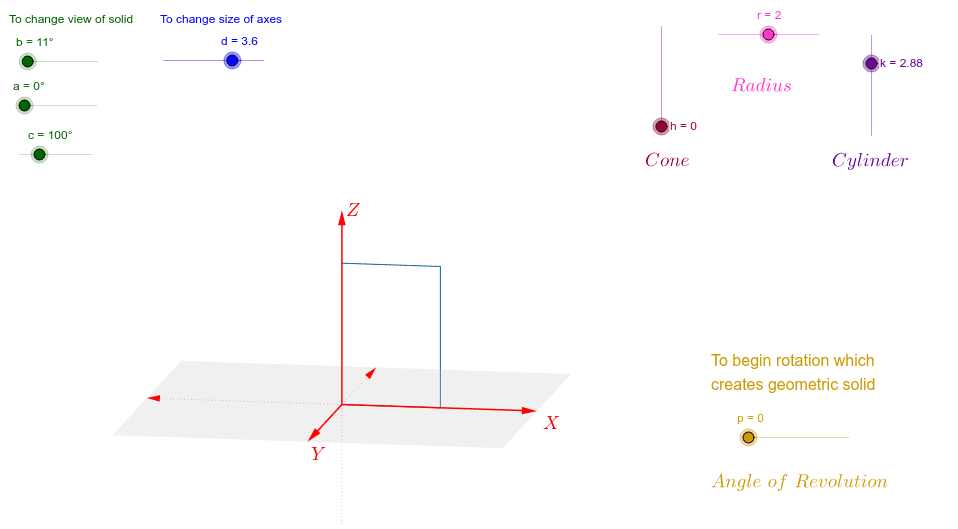
This example demonstrates how to construct a cone and a cylinder using GeoGebra. The core mathematical concepts involved are solid geometry, specifically cones and cylinders. Using commands such as Vector, Polygon, Sequence, and CurveCartesian, the geometric models of cones and cylinders can be constructed. Suitable for middle school and above students or teachers to help understand basic concepts of solid geometry.
GeoGebra Commands & Parameters
Vector(((1.1 * d) * W_x)) → uVector(((1.1 * d) * W_y)) → vVector(((1.1 * d) * W_z)) → wPolygon(((1.1 * d) * (W_x + W_y)), ((1.1 * d) * ((-W_x) + W_y)), ((1.1 * d) * ((-W_x) - W_y)), ((1.1 * d) * (W_x - W_y))) → poly1, g, i, j, lSequence(((r * cos((0.125 * i))) * W_x) + ((r * sin((0.125 * i))) * W_y), i, 0, p) → list1Sequence(((r * cos((0.125 * i))) * W_x) + ((r * sin((0.125 * i))) * W_y) + (k * W_z), i, 0, p) → list3CurveCartesian(x(((r * cos((0.125 * i))) * W_x) + ((r * sin((0.125 * i))) * W_y)), y(((r * cos((0.125 * i))) * W_x) + ((r * sin((0.125 * i))) * W_y)), i, 0, p) → e_1CurveCartesian(x(((r * cos((0.125 * t))) * W_x) + ((r * sin((0.125 * t))) * W_y) + (k * W_z)), y(((r * cos((0.125 * t))) * W_x) + ((r * sin((0.125 * t))) * W_y) + (k * W_z)), t, 0, p) → e_2Sequence(Segment[A, Element[list1, i]], i, 1, p + 1) → list2Sequence(Segment[Element[list1, i], Element[list3, i]], i, 1, p + 1) → list4Sequence(Segment[(0, 0) + (k * W_z), Element[list3, i]], i, 1, p + 1) → list5