
Connectivity Matrix
Loading the math board and drawing, please wait…
In collections
Solids, graphs and paths
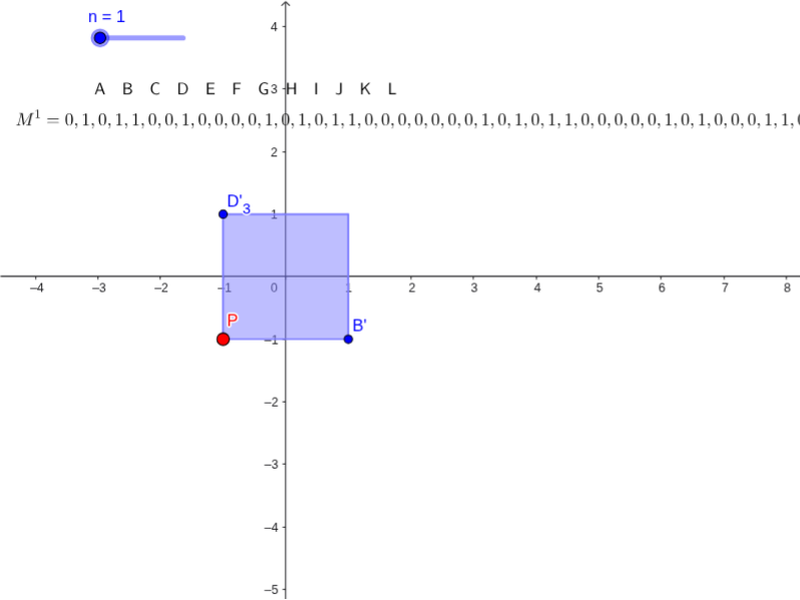
This example demonstrates the concept of a connectivity matrix, involving core mathematical concepts of matrices and transformations. Using GeoGebra commands such as Polygon, Mirror, Point, and Line, it constructs a polygon and its mirror image, illustrating how a connectivity matrix describes the relationships between shapes. Suitable for high school mathematics education and learning.
GeoGebra Commands & Parameters
Polygon(A, B, C, D) → vierhoek1, a, b, c, dMirror(A, B) → A'Mirror(B, B) → B'Mirror(C, B) → C'Mirror(D, B) → D'Polygon(A', B', C', D') → vierhoek1', a', b', c', d'Point(yAxis) → E_1Point(xAxis) → F_1Line(E_1, F_1) → fMirror(A, A) → A'_1Mirror(B, A) → B'_1Mirror(C, A) → C'_1Mirror(D, A) → D'_1Polygon(A'_1, B'_1, C'_1, D'_1) → vierhoek1'_1, a'_1, b'_1, c'_1, d'_1Point(xAxis) → G_1Line(G_1, E_1) → gMirror(A, C) → A'_2Mirror(B, C) → B'_2Mirror(C, C) → C'_2Mirror(D, C) → D'_2Polygon(A'_2, B'_2, C'_2, D'_2) → vierhoek1'_2, a'_2, b'_2, c'_2, d'_2Mirror(A, D) → A'_3Mirror(B, D) → B'_3Mirror(C, D) → C'_3Mirror(D, D) → D'_3Polygon(A'_3, B'_3, C'_3, D'_3) → vierhoek13, a'_3, b'_3, c'_3, d'_3Point(yAxis) → H_1Line(G_1, H_1) → iLine(H_1, F_1) → jRotate(vierhoek1', (-(90°)), f) → vierhoek12Rotate(vierhoek1'_2, 90°, j) → vierhoek2Rotate(vierhoek13, 90°, i) → vierhoek3Rotate(vierhoek1'_1, (-(90°)), g) → vierhoek4Rotate(D', (-(90°)), f) → JTranslate(vierhoek1, Vector[(0, 0, z(J))]) → vierhoek14Rotate(C', (-(90°)), f) → ERotate(C'_1, (-(90°)), g) → IRotate(C'_3, 90°, i) → HRotate(B'_3, 90°, i) → LRotate(B'_2, 90°, j) → GRotate(A'_2, 90°, j) → KRotate(A', (-(90°)), f) → FPolygon(J, F, K) → driehoek1, m, d'', a''Polygon(B, C, F) → driehoek2, a''_1, b_1, c_1Polygon(K, G, L) → driehoek3, k, m_1, lPolygon(C, D, G) → driehoek4, l_1, c_2, d_1Polygon(L, H, I) → driehoek5, i_1, k_1, j_1Polygon(A, H, D) → driehoek6, d_2, a_1, j_2Point(ribben3) → PTableText({{"A", "B", "C", "D", "E", "F", "G", "H", "I", "J", "K", "L"}}) → tekst1TableText({{"A"}, {"B"}, {"C"}, {"D"}, {"E"}, {"F"}, {"G"}, {"H"}, {"I"}, {"J"}, {"K"}, {"L"}}) → tekst2