
Conic Tracing: Dynamic Construction of Parabola, Ellipse, and Hyperbola
Loading the math board and drawing, please wait…
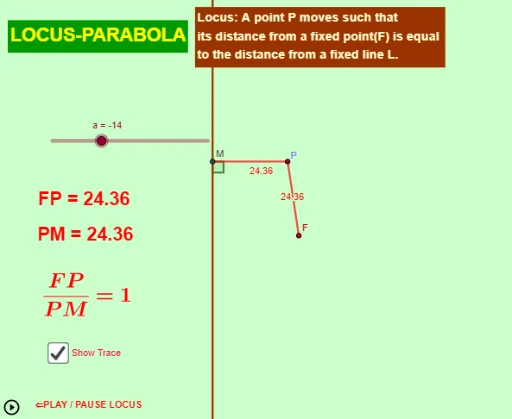
①This example demonstrates the formation of conic sections (parabola, ellipse, hyperbola) through dynamic point tracing, revealing how geometric elements like equilateral triangles, perpendicular lines, and angles interact with the curves. ②Core mathematical concepts include conic sections, locus, orthogonal lines, angle relationships, and the integration of function graphs with geometric construction. ③Construction highlights: using GeoGebra commands such as Parabola, Point, OrthogonalLine, Intersect, Angle, and Segment, with the ShowTrace feature enabled to visualize the path of moving points (e.g., B, D). Text labels and images are included for annotation. ④Suitable for high school or early college analytic geometry and conic section lessons, as well as dynamic geometry exploration, helping learners understand the connection between curve traces and geometric constraints.
GeoGebra Commands & Parameters
Parabola(A, c) → dPoint(d) → COrthogonalLine(C, c) → hIntersect(h, c) → EAngle(c, h) → αSegment(E, C) → fSegment(C, A) → gIntersect(g, f) → FPoint(n) → JPoint(r) → LPoint(s) → NPoint(t) → P
AI Drawing Prompt Reference
Draw a dynamic illustration showing the formation of parabolas, ellipses, and hyperbolas through point tracing, revealing how geometric elements like equilateral triangles, perpendicular lines, and angles interact with the curves. Include core concepts of conic sections, locus, orthogonal lines, angle relationships, and the integration of function graphs with geometric constructions. Use dynamic points to trace paths and annotate geometric elements and relationships, suitable for high school or early college analytic geometry and conic section lessons.
The prompt above was compiled from the original drawing commands and is for reference only.