
Congruent Triangles Investigation
Loading the math board and drawing, please wait…
In collections
Butterflies, Pinwheels, and Wallpaper
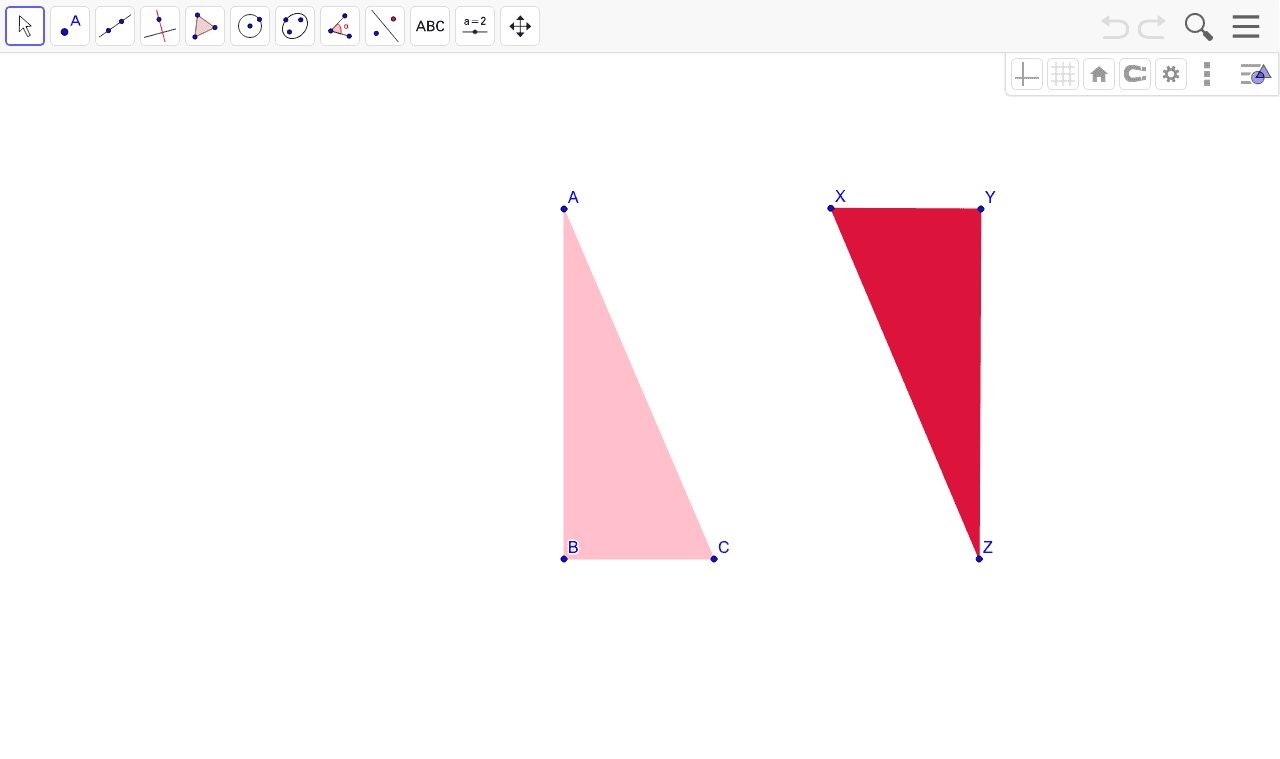
This example demonstrates how to construct congruent triangles using mirror transformations. The core math concepts involved include triangle congruence criteria, reflection transformations, and geometric construction. The construction uses GeoGebra commands and objects such as Polygon, Line, Mirror, and Point. It is suitable for middle school mathematics teaching, helping students understand the properties and applications of transformations in congruent triangles.
GeoGebra Commands & Parameters
Polygon(A, B, C) → poly1, c, a, bLine(D, E) → dMirror(A, d) → A'Mirror(B, d) → B'Mirror(C, d) → C'Polygon(A', B', C') → poly1', c', a', b'Point(c) → FPoint(c') → GLine(F, G) → eMirror(A', e) → ZMirror(B', e) → YMirror(C', e) → XPolygon(Z, Y, X) → poly1'', c'', a'', b''
AI Drawing Prompt Reference
Draw an arbitrary triangle. Then draw a straight line as an axis of symmetry. Reflect the three vertices of the triangle across this line to obtain a second congruent triangle. Next, pick a point on one side of the first triangle and a corresponding point on the matching side of the second triangle, and connect these two points with a new line. Reflect the three vertices of the second triangle across this new line to form a third congruent triangle. The final figure shows three congruent triangles, two mirror lines, and several auxiliary points, illustrating how successive reflections preserve congruence.
The prompt above was compiled from the original drawing commands and is for reference only.