
Congruent Chords Theorem Demo
Loading the math board and drawing, please wait…
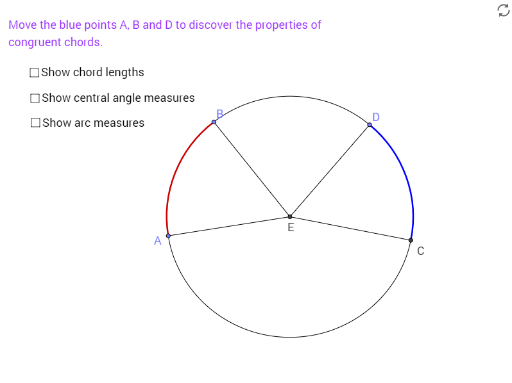
This example demonstrates the property that congruent chords in a circle subtend equal angles at the circle's circumference. It involves core concepts like circles, chords, inscribed angles, and the congruence theorem. Construction uses GeoGebra commands such as Point, Circle, Segment, Intersect, Angle, and CircleArc to visualize the chords and their corresponding angles, suitable for high school geometry education.
GeoGebra Commands & Parameters
Point(yAxis) → OPoint(xAxis) → ZCircle(O, Z) → cPoint(c) → APoint(c) → BSegment(A, B) → aPoint(c) → DCircle(D, a) → dIntersect(c, d) → F, C, ,Segment(C, D) → bSegment(B, O) → eSegment(A, O) → fSegment(C, O) → gSegment(D, O) → hAngle(B, O, A) → αAngle(C, O, D) → βCircleArc(O, B, A) → kCircleArc(O, C, D) → pIntersect(e, f) → ECircleArc(E, B, A) → qCircleArc(E, C, D) → rAngle(B, E, A) → γAngle(C, E, D) → δ
AI Drawing Prompt Reference
Draw a circle and two equal chords inside it. Connect each chord's endpoints to the circle's center. Draw a circle with one chord as its diameter to find points on the circle corresponding to the chords. Measure and compare the inscribed angles subtended by the chords, showing they are equal. Also, compare the angles formed by the center and the midpoint of each chord. Use arcs to represent these angles and label key points and segments.
The prompt above was compiled from the original drawing commands and is for reference only.