
Congruent Angles: Definition
Loading the math board and drawing, please wait…
In collections
Congruence Review 1
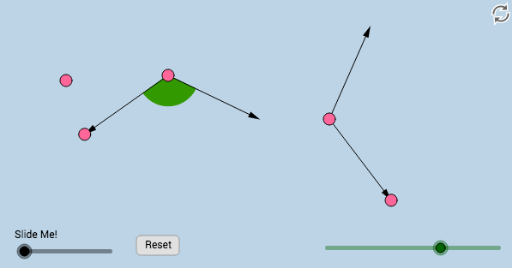
This example dynamically illustrates to students what it means for two angles to be congruent with respect to geometric transformations, covering core concepts like angles, rotation, geometric transformations, and translation. It is constructed using GeoGebra commands such as Circle, Point, Rotate, Angle, Vector, Segment, Intersect, CircleSector, Line, Dilate, and Translate, making it suitable for middle school and above students learning about geometric transformations and congruent angles.
GeoGebra Commands & Parameters
Circle(A, B) → cPoint(c) → CRotate(C, α, A) → C'Angle(C, A, C') → βVector(A, C) → uVector(A, C') → vSegment(A, B) → bCircle(D, b) → dPoint(d) → ERotate(E, α, D) → E'Angle(E, D, E') → γVector(D, E) → wVector(D, E') → eCircle(A, (0.3 * b)) → fCircle(D, (0.3 * b)) → gSegment(A, C) → hSegment(A, C') → iSegment(D, E) → jSegment(D, E') → kIntersect(f, h, 1) → FIntersect(f, i, 1) → GIntersect(g, j, 1) → HIntersect(g, k, 1) → ICircleSector(A, F, G) → pLine(A, j) → lIntersect(f, l, 2) → JAngle(J, A, F) → δDilate(A, If[0 < m ≤ 1, 1 - m, 0], D) → A'Vector(A, A') → nTranslate(p, n) → p'Rotate(p', If[1 < m ≤ 2, ((-(m - 1)) * δ), (-δ)], D) → p''