
Conditions for Triangles to be Congruent
Loading the math board and drawing, please wait…
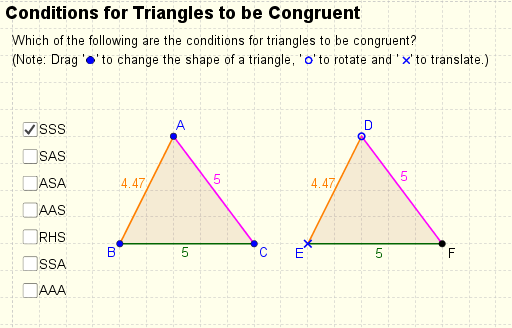
This example demonstrates the conditions for triangles to be congruent. By constructing triangles and related elements such as side lengths, angles, and rotations, students can visually understand the congruence theorems. Commands used include Segment, Circle, Point, Intersect, Polygon, Angle, and Rotate. Suitable for junior high school geometry.
GeoGebra Commands & Parameters
Segment(A_1, B_1) → a_1Circle(A_1, B_1) → circle1_1Circle(C_1, B_1) → circle1_2Segment(B_1, C_1) → b_1Segment(C_1, A_1) → c_1Point(Circle[E_1, abs(a_1)]) → D_1Circle(D_1, c_1) → circle1_3Circle(E_1, b_1) → circle1_4Intersect(circle1_3, circle1_4, 1) → F_1Segment(D_1, E_1) → d_1Segment(E_1, F_1) → e_1Segment(D_1, F_1) → f_1Polygon(A_1, B_1, C_1) → poly1_1, mc_1, ma_1, mb_1Polygon(D_1, E_1, F_1) → poly1_2, mf_1, md_1, me_1Circle(B_2, A_2) → circle2_1Circle(B_2, C_2) → circle2_2Segment(A_2, B_2) → a_2Segment(B_2, C_2) → b_2Segment(A_2, C_2) → c_2Angle(C_2, B_2, A_2) → α_21Circle(E_2, a_2) → circle2_3Circle(E_2, b_2) → circle2_4Point(circle2_3) → D_2Rotate(D_2, (-α_21), E_2) → E_2'Line(E_2, E_2') → line2'Intersect(circle2_4, line2', 2) → F_2Segment(D_2, E_2) → d_2Segment(E_2, F_2) → e_2Segment(D_2, F_2) → f_2Angle(F_2, E_2, D_2) → α_22Polygon(A_2, B_2, C_2) → poly2_1, mc_2, ma_2, mb_2Polygon(D_2, E_2, F_2) → poly2_2, mf_2, md_2, me_2Segment(B_{34}, C_{34}) → b_{34}Circle(B_{34}, C_{34}) → circle34_1Segment(B_{34}, A_{34}) → a_{34}Segment(C_{34}, A_{34}) → c_{34}Angle(C_{34}, B_{34}, A_{34}) → α_31Angle(B_{34}, C_{34}, A_{34}) → β_31Circle(E_{34}, b_{34}) → circle34_2Point(circle34_2) → F_{34}Rotate(F_{34}, α_31, E_{34}) → F_{34}'Rotate(E_{34}, (-β_31), F_{34}) → E_{34}'Line(E_{34}, F_{34}') → line34_1'Line(F_{34}, E_{34}') → line34_2'Intersect(line34_1', line34_2') → D_{34}Segment(D_{34}, E_{34}) → d_{34}Segment(E_{34}, F_{34}) → e_{34}Segment(D_{34}, F_{34}) → f_{34}Angle(F_{34}, E_{34}, D_{34}) → α_32Angle(D_{34}, F_{34}, E_{34}) → β_32Polygon(A_{34}, B_{34}, C_{34}) → poly34_1, ma_3, mb_3, mc_3Polygon(D_{34}, E_{34}, F_{34}) → poly34_2, md_3, me_3, mf_3Angle(C_{34}, A_{34}, B_{34}) → β_41Angle(F_{34}, D_{34}, E_{34}) → β_42Segment(A_5, C_5) → c_5OrthogonalLine(C_5, c_5) → line5_1'Point(line5_1') → B_5Segment(A_5, B_5) → a_5Segment(B_5, C_5) → b_5Circle(D_5, c_5) → circle5_1Point(circle5_1) → F_5Segment(D_5, F_5) → f_5OrthogonalLine(F_5, f_5) → line5_2'Circle(D_5, a_5) → circle5_2Intersect(circle5_2, line5_2', 1) → E_5Segment(D_5, E_5) → d_5Segment(E_5, F_5) → e_5Angle(A_5, C_5, B_5) → α_51Angle(D_5, F_5, E_5) → α_52Polygon(A_5, B_5, C_5) → poly5_1, mc_5, ma_5, mb_5Polygon(D_5, E_5, F_5) → poly5_2, mf_5, md_5, me_5Segment(A_6, B_6) → a_6Circle(B_6, A_6) → circle6_1Circle(A_6, C_6) → circle6_2Segment(B_6, C_6) → b_6Segment(A_6, C_6) → c_6Circle(D_6, a_6) → circle6_3Point(circle6_3) → E_6Circle(D_6, c_6) → circle6_4Angle(C_6, B_6, A_6) → α_61Rotate(D_6, (-α_61), E_6) → F_6'Line(E_6, F_6') → line6'Intersect(circle6_4, line6', 1) → F_6Segment(D_6, E_6) → d_6Segment(E_6, F_6) → e_6Segment(D_6, F_6) → f_6Angle(F_6, E_6, D_6) → α_62Polygon(A_6, B_6, C_6) → poly6_1, mc_6, ma_6, mb_6Polygon(D_6, E_6, F_6) → poly6_2, mf_6, md_6, me_6Segment(A_7, B_7) → a_7Segment(B_7, C_7) → b_7Segment(A_7, C_7) → c_7Segment(D_7, E_7) → d_7Angle(C_7, A_7, B_7) → α_71Angle(A_7, B_7, C_7) → β_71Angle(B_7, C_7, A_7) → γ_71Rotate(E_7, (-α_71), D_7) → F_71'Rotate(D_7, β_71, E_7) → F_72'Line(D_7, F_71') → line7_1'Line(E_7, F_72') → line7_2'Intersect(line7_1', line7_2') → F_7Segment(D_7, F_7) → e_7Segment(E_7, F_7) → f_7Angle(F_7, D_7, E_7) → α_72Angle(D_7, E_7, F_7) → β_72Angle(E_7, F_7, D_7) → γ_72Polygon(A_7, B_7, C_7) → poly7_1, mc_7, ma_7, mb_7Polygon(D_7, E_7, F_7) → poly7_2, mf_7, md_7, me_7
AI Drawing Prompt Reference
Draw two triangles with labeled vertices and sides, use circles to represent side lengths and angle symbols for the three interior angles, demonstrate the conditions for triangle congruence through rotation and intersection operations, including side-side-side, side-angle-side, and angle-side-angle cases, with different colors to distinguish the two triangles for observing congruence relationships.
The prompt above was compiled from the original drawing commands and is for reference only.