
Compressed Astroid as Envelope: A Classical Construction
Loading the math board and drawing, please wait…
In collections
History of Maths
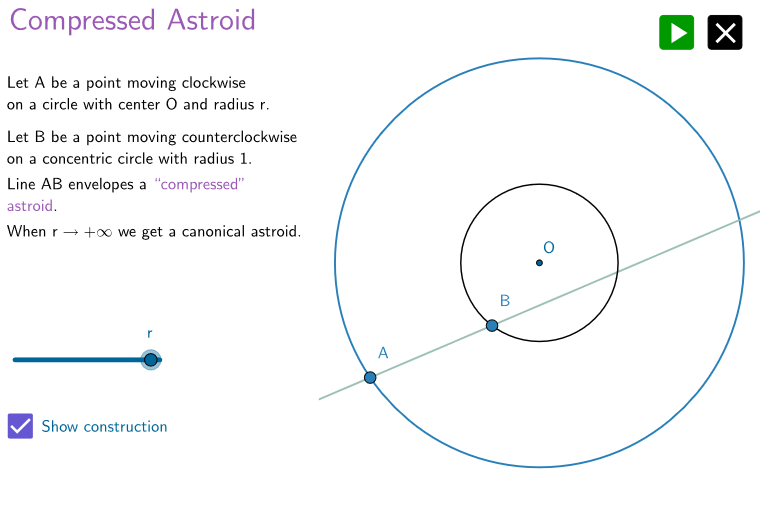
This GeoGebra example demonstrates how to construct a 'compressed astroid' as the envelope of a family of lines or segments, using classical geometric methods. The astroid is a four-cusped hypocycloid, typically generated by a circle of radius R rolling inside a circle of radius R/4; the compressed version modifies the proportions or applies a projection to flatten the curve along one direction, yielding a squashed star-like shape. Core mathematical concepts include envelope curves, hypocycloids, right triangles, the Pythagorean theorem, orthocenters, and geometric distributions. The construction uses GeoGebra commands such as Circle, Point, Line, and Slope, with objects including r (radius), c (circle), A and B (points), O (center), f (function or locus), and slo (slope). Interactive elements include sliders (speed, btnStart, btnStop) for animation, a trace-clearing button (btnDelTrace), and language toggles (btnIt, btnEn). This resource is suitable for high school or early college geometry and analytic geometry courses, helping students understand the concept of envelopes, parametric curves, and the interplay between algebraic and geometric constructions. It also serves as a rich material for mathematical exploration and inquiry-based learning.
GeoGebra Commands & Parameters
Circle((0, 0), r) → cPoint(c) → APoint(eq1) → BLine(A, B) → invilSlope(invil) → slo
AI Drawing Prompt Reference
Draw a compressed astroid as the envelope of a line. Start with a circle of radius r. Then connect points A and B with a line. Use the slope slo to define the line's direction. Ensure the shape is a four-cusped star that is flattened along one direction, creating a squashed star-like form.
The prompt above was compiled from the original drawing commands and is for reference only.