
Compositions & Dilations: Exploring Combined Transformations
Loading the math board and drawing, please wait…
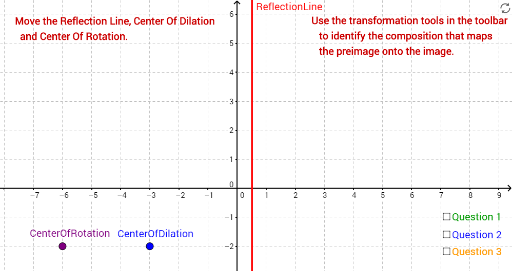
① This example demonstrates how multiple geometric transformations (reflection, dilation, rotation) are composed and applied to polygons, showing the dynamic changes and the correspondence between original and transformed figures. ② Core mathematical concepts include dilation, reflection, rotation, and the composition of transformations in plane geometry, with extensions to isosceles triangles, curve sketching, complex numbers, and sequences. ③ Construction highlights: using GeoGebra commands such as Intersect, Point, Polygon, Mirror, Dilate, and Rotate to build and transform polygon poly1 into poly1'; defining CenterOfDilation as the dilation center; using sliders (n, l, m) to control parameters for dynamic exploration; objects include points A, B, C, O, P, Q, etc., and auxiliary lines l, m, n with text4. ④ Suitable for high school or early college geometry courses, and for teachers creating interactive lessons to help students understand the order and effects of composed transformations.
GeoGebra Commands & Parameters
Intersect(xAxis, yAxis) → IPoint(yAxis) → KPolygon(L, M, N) → poly1, n, l, mPolygon(O, P, Q, R, S) → poly2, o, p, q, r, s_1Intersect(b, xAxis) → BMirror(L, b) → L'Mirror(M, b) → M'Mirror(N, b) → N'Polygon(L', M', N') → poly1', n', l', m'Dilate(L', 0.5, B) → L''Dilate(M', 0.5, B) → M''Dilate(N', 0.5, B) → N''Polygon(L'', M'', N'') → poly1'', n'', l'', m''Mirror(O, c) → O'Mirror(P, c) → P'Mirror(Q, c) → Q'Mirror(R, c) → R'Mirror(S, c) → S'Polygon(O', P', Q', R', S') → poly2', o', p', q', r', s'Dilate(O', 2, I) → O''Dilate(P', 2, I) → P''Dilate(Q', 2, I) → Q''Dilate(R', 2, I) → R''Dilate(S', 2, I) → S''Polygon(O'', P'', Q'', R'', S'') → poly2'', o'', p'', q'', r'', s''Polygon(D, E, G) → poly3, g, d_1, eRotate(D, 90°, B) → D'Rotate(E, 90°, B) → E'Rotate(G, 90°, B) → G'Polygon(D', E', G') → poly3', g', d', e'Dilate(D', 0.3333333333333333, B) → D''Dilate(E', 0.3333333333333333, B) → E''Dilate(G', 0.3333333333333333, B) → G''Polygon(D'', E'', G'') → poly3'', g'', d'', e''
AI Drawing Prompt Reference
On a coordinate plane, draw a triangle and a pentagon. Reflect the triangle across a line, then dilate the reflected triangle by a factor of 0.5 about the line's intersection with the x-axis. Reflect the pentagon across another line, then dilate it by a factor of 2 about the origin. Additionally, take a third triangle, rotate it 90 degrees about a fixed point, then dilate it by one-third about that same point. Keep all original and transformed shapes visible, using distinct colors or styles to show the composition of transformations.
The prompt above was compiled from the original drawing commands and is for reference only.