
Complex Sine Mapping
Loading the math board and drawing, please wait…
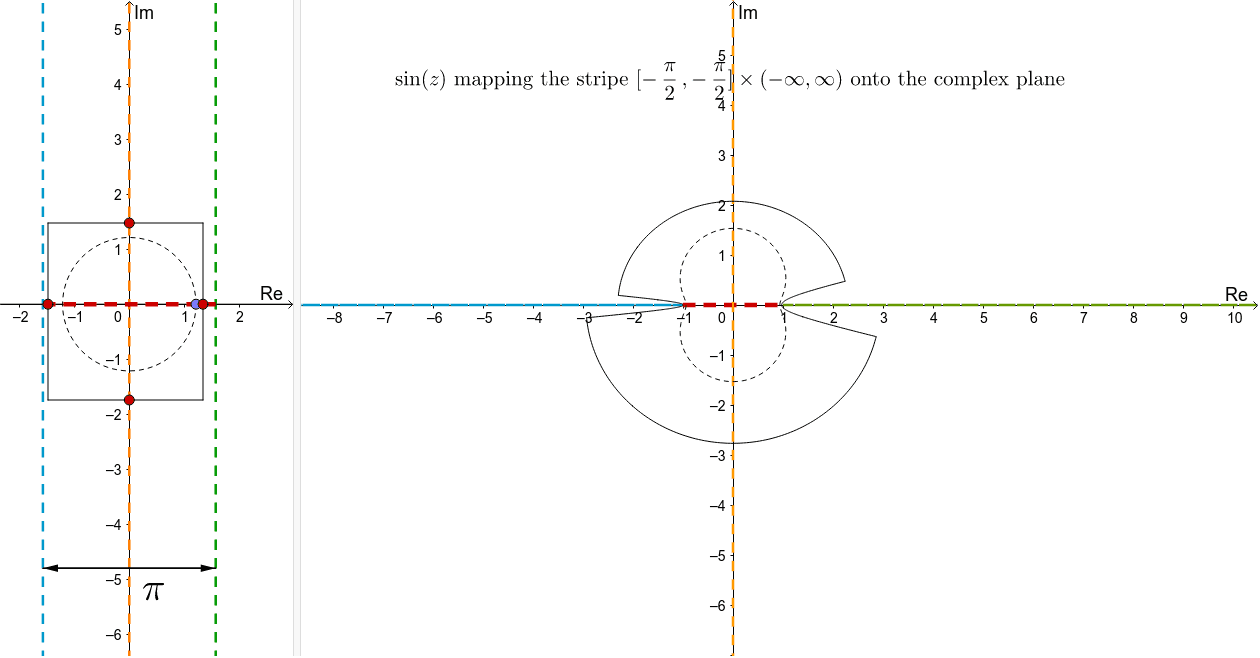
This example illustrates how the complex sine maps a stripe in the complex plane into the entire complex plane. Key mathematical concepts include complex numbers and trigonometric functions. Using GeoGebra commands such as Segment, Point, and Locus, the mapping effect of the complex sine can be constructed. Suitable for high school mathematics education and learning about transformations of complex numbers and trigonometric functions.
GeoGebra Commands & Parameters
Segment(A, B) → bPoint(b) → CLocus(E, C) → loc1Line(D, F) → cPoint(c) → GLocus(H, G) → loc2OrthogonalLine(A, b) → dPoint(d) → ILocus(J, I) → loc3OrthogonalLine(B, b) → ePoint(e) → KLocus(L, K) → loc4Point(b) → OCircle(C, O) → kPoint(c) → PPoint(c) → QPoint(b) → RPoint(b) → SOrthogonalLine(Q, c) → iOrthogonalLine(R, c) → jOrthogonalLine(P, c) → lOrthogonalLine(R, b) → mOrthogonalLine(S, b) → pIntersect(m, l) → TIntersect(p, l) → UIntersect(i, p) → VIntersect(m, i) → WPolygon(W, V, U, T) → poly1, w, v, u, tPoint(u) → ZLocus(A_1, Z) → loc5Point(w) → B_1Locus(C_1, B_1) → loc6Point(t) → D_1Locus(E_1, D_1) → loc7Point(v) → F_1Locus(G_1, F_1) → loc8Point(k) → H_1Locus(I_1, H_1) → loc9Vector(J_1, K_1) → zVector(K_1, J_1) → n
AI Drawing Prompt Reference
Draw a strip in the complex plane and map it to the entire complex plane using the complex sine function. First, draw a line segment AB, then take a point C on this segment and construct the trajectory of the complex sine function through C. Next, draw a line c perpendicular to AB and take a point G on c, then construct the trajectory of G. Continue by drawing lines d and e perpendicular to c and taking points I and K on d and e, respectively, and construct the trajectories of I and K. Then, draw a circle k with C as its center and take points P, Q, R, and S on c, and construct the trajectories of P, Q, R, and S. Next, draw perpendicular lines from P, Q, R, and S and find the intersections W, V, U, and T of these lines, then connect W, V, U, and T to form a quadrilateral. Finally, construct the mapping trajectories through these points.
The prompt above was compiled from the original drawing commands and is for reference only.