
Complex Roots by Mr Hardman
Loading the math board and drawing, please wait…
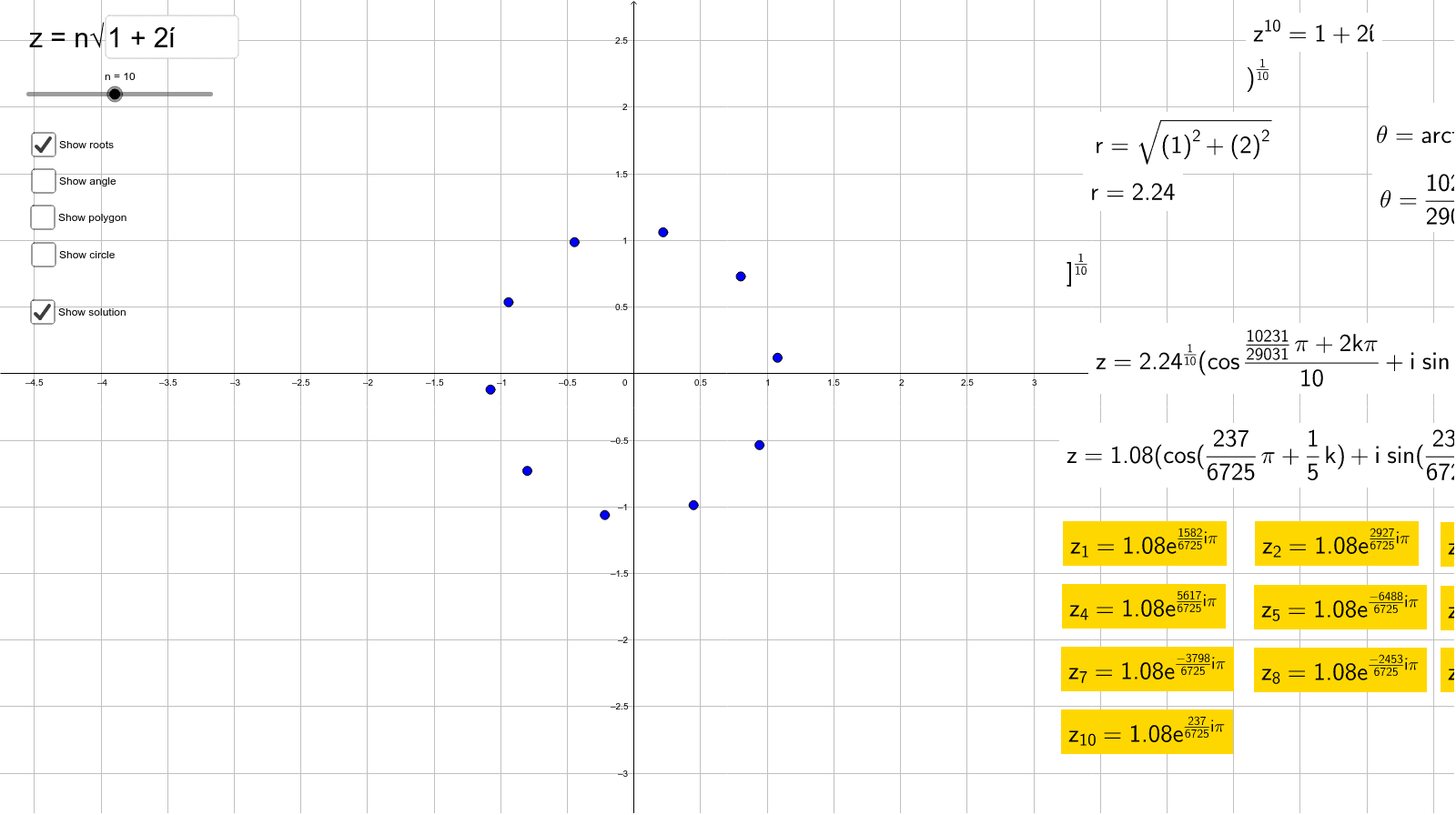
This example illustrates the concept of complex roots. It involves the geometric representation and algebraic properties of complex numbers. Using GeoGebra commands such as Sequence, Point, Distance, etc., it dynamically demonstrates the properties of complex roots. Suitable for high school mathematics education, particularly in complex numbers and coordinate geometry.
GeoGebra Commands & Parameters
Sequence((a^(1 / n) * (cos(((2 * π) * k / n)) + (ί * sin(((2 * π) * k / n))))), k, 1, n) → list2Point(yAxis) → APoint(list2) → BDistance(B, (0, 0)) → fTextfield(a) → inputBox1Intersect(xAxis, yAxis) → CPoint(list2) → DPoint(list2) → EAngle(D, C, E) → αIntersect(e, xAxis, 2) → FPoint(list2) → GPoint(list2) → HPoint(list2) → IPoint(list2) → JAngle(Element[list2, n], (0, 0), Element[list2, 1]) → δSegment(J, A) → dPoint(list2) → KPoint(list2) → LSegment(Element[list2, n], (0, 0)) → jPolygon(list2) → poly1FractionText(arg(a) / π) → text10FractionText(θ) → text11FractionText(2 / n) → text12FractionText(Element[list4, 1]) → text14FractionText(Element[list4, 2]) → text15FractionText(Element[list4, 3]) → text16FractionText(Element[list4, 4]) → text20FractionText(Element[list4, 5]) → text21FractionText(Element[list4, 6]) → text22FractionText(Element[list4, 7]) → text23FractionText(Element[list4, 8]) → text24FractionText(Element[list4, 9]) → text25FractionText(Element[list4, 10]) → text26Sequence((a_1^(1 / n) * (cos(((2 * π) * k / n)) + (ί * sin(((2 * π) * k / n))))), k, 1, n) → list2_1Point(list2_1) → B_1Textfield(a_1) → inputBox1_1Point(list2_1) → D_1Point(list2_1) → E_1Point(list2_1) → G_1Point(list2_1) → H_1Point(list2_1) → I_1Point(list2_1) → J_1Point(list2_1) → K_1Point(list2_1) → L_1Polygon(list2_1) → poly1_1FractionText(Element[list4_1, 3]) → text16_1Sequence((a_2^(1 / n) * (cos(((2 * π) * k / n)) + (ί * sin(((2 * π) * k / n))))), k, 1, n) → list2_2Point(list2_2) → B_2Textfield(a_2) → inputBox1_2Point(list2_2) → D_2Point(list2_2) → E_2Point(list2_2) → G_2Point(list2_2) → H_2Point(list2_2) → I_2Point(list2_2) → J_2Point(list2_2) → K_2Point(list2_2) → L_2Polygon(list2_2) → poly1_2FractionText(Element[list4_2, 4]) → text20_1Sequence((a_3^(1 / n) * (cos(((2 * π) * k / n)) + (ί * sin(((2 * π) * k / n))))), k, 1, n) → list2_3Point(list2_3) → B_3Textfield(a_3) → inputBox1_3Point(list2_3) → D_3Point(list2_3) → E_3Point(list2_3) → G_3Point(list2_3) → H_3Point(list2_3) → I_3Point(list2_3) → J_3Point(list2_3) → K_3Point(list2_3) → L_3Polygon(list2_3) → poly1_3FractionText(Element[list4_3, 6]) → text22_1Sequence((a_4^(1 / n) * (cos(((2 * π) * k / n)) + (ί * sin(((2 * π) * k / n))))), k, 1, n) → list2_4Point(list2_4) → B_4Textfield(a_4) → inputBox1_4Point(list2_4) → D_4Point(list2_4) → E_4Point(list2_4) → G_4Point(list2_4) → H_4Point(list2_4) → I_4Point(list2_4) → J_4Point(list2_4) → K_4Point(list2_4) → L_4Polygon(list2_4) → poly1_4FractionText(Element[list4_4, 6]) → text22_2Sequence((a_5^(1 / n) * (cos(((2 * π) * k / n)) + (ί * sin(((2 * π) * k / n))))), k, 1, n) → list2_5Point(list2_5) → B_5Textfield(a_5) → inputBox1_5Point(list2_5) → D_5Point(list2_5) → E_5Point(list2_5) → G_5Point(list2_5) → H_5Point(list2_5) → I_5Point(list2_5) → J_5Point(list2_5) → K_5Point(list2_5) → L_5Polygon(list2_5) → poly1_5FractionText(Element[list4_5, 7]) → text23_1Sequence((a_6^(1 / n) * (cos(((2 * π) * k / n)) + (ί * sin(((2 * π) * k / n))))), k, 1, n) → list2_6Point(list2_6) → B_6Textfield(a_6) → inputBox1_6Point(list2_6) → D_6Point(list2_6) → E_6Point(list2_6) → G_6Point(list2_6) → H_6Point(list2_6) → I_6Point(list2_6) → J_6Point(list2_6) → K_6Point(list2_6) → L_6Polygon(list2_6) → poly1_6FractionText(Element[list4_6, 8]) → text24_1Sequence((a_7^(1 / n) * (cos(((2 * π) * k / n)) + (ί * sin(((2 * π) * k / n))))), k, 1, n) → list2_7Point(list2_7) → B_7Textfield(a_7) → inputBox1_7Point(list2_7) → D_7Point(list2_7) → E_7Point(list2_7) → G_7Point(list2_7) → H_7Point(list2_7) → I_7Point(list2_7) → J_7Point(list2_7) → K_7Point(list2_7) → L_7Polygon(list2_7) → poly1_7FractionText(Element[list4_7, 10]) → text25_1Vector((0, 0), a) → u
AI Drawing Prompt Reference
Draw the geometric representation of the n-th roots of a complex number. Start by taking a point A on the x-axis, then generate n complex roots based on the given complex number a and the definition of n-th roots, and plot them on the complex plane to form a regular polygon. Calculate the distance f from each root to the origin, and mark the angle α. Draw line segments from the origin to each root, and calculate the angle δ between each root and its adjacent root. Finally, draw a polygon containing all the roots and label the argument of each root.
The prompt above was compiled from the original drawing commands and is for reference only.