
Complex Roots and Rotated Parabola Geometry
Loading the math board and drawing, please wait…
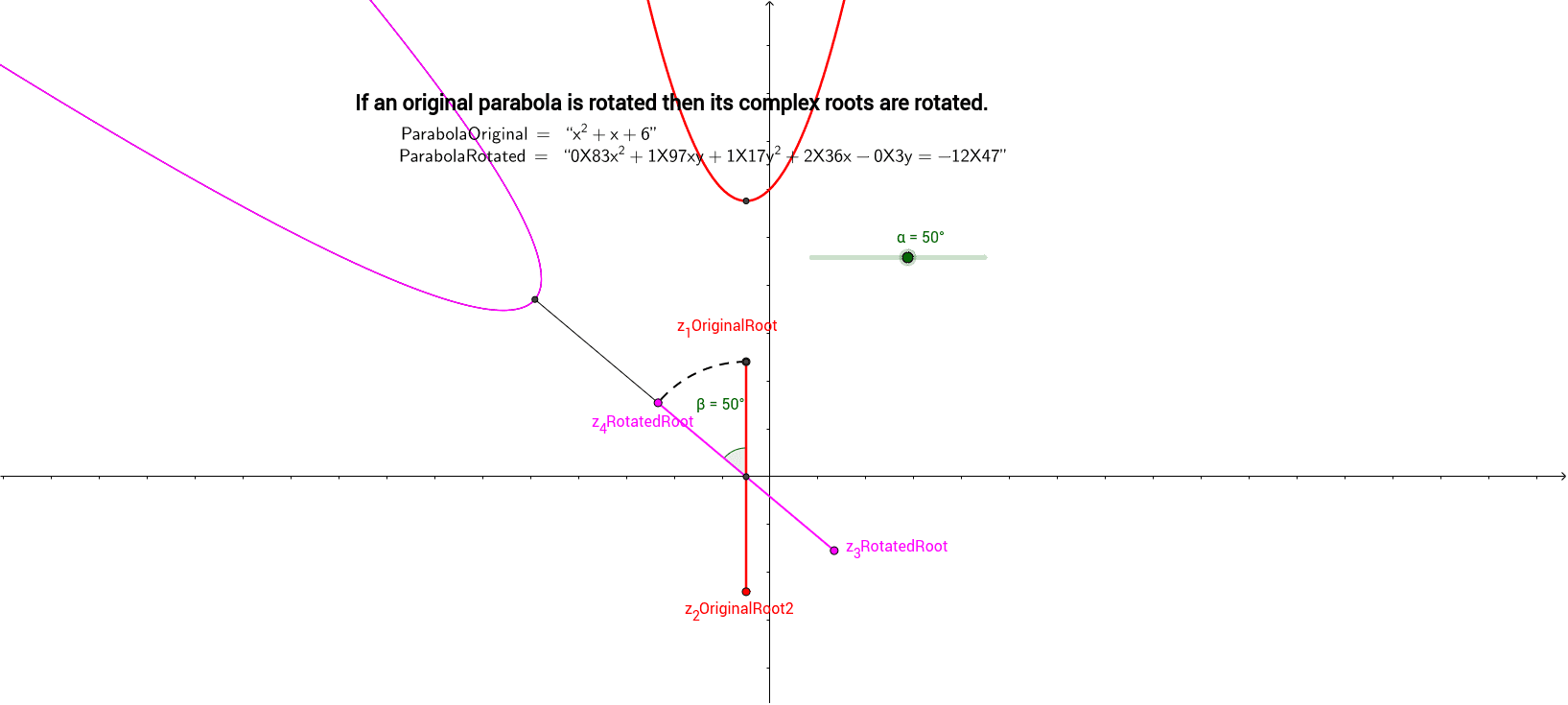
This GeoGebra example demonstrates the geometric relationship between complex roots and rotated parabolas. Key concepts include complex numbers, quadratic functions, rotation transformations, and calculus derivatives. Construction utilizes commands like ComplexRoot, Rotate, Parabola, Conic, and Intersect to visualize how complex roots influence the orientation and shape of the parabola. It is designed for high school or university students studying analytic geometry and complex analysis, providing an interactive tool to explore the connection between algebraic roots and geometric curves.
GeoGebra Commands & Parameters
ComplexRoot(x^(2) + x + 6) → z_1OriginalRoot, z_2OriginalRoot2Midpoint(z_2OriginalRoot2, z_1OriginalRoot) → IMin(ParabolaOriginal_1, -10, 10) → JCircle(I, J) → pIntersect(ParabolaOriginal_1, xAxis, 1) → CIntersect(ParabolaOriginal_1, xAxis, 2) → DRotate(ParabolaOriginal_1, α, I) → CurveRotatedPoint(CurveRotated) → ZPoint(CurveRotated) → A_1Point(CurveRotated) → B_1Point(CurveRotated) → C_1Rotate(J, α, I) → J'Conic(Z, A_1, J', B_1, C_1) → eSegment(z_1OriginalRoot, z_2OriginalRoot2) → gRotate(z_1OriginalRoot, α, I) → z_4RotatedRootRotate(z_2OriginalRoot2, α, I) → z_3RotatedRootSegment(z_4RotatedRoot, z_3RotatedRoot) → g'CircleArc(I, z_1OriginalRoot, z_4RotatedRoot) → hAngle(z_1OriginalRoot, I, z_4RotatedRoot) → βFocus(e) → B,Directrix(e) → f,Parabola(B, f) → ParabolaRotated_1Segment(J', z_4RotatedRoot) → iIntersect(f, i) → EIntersect(ParabolaRotated_1, p) → F, G, ,Parabola(B, f) → qLaTeX(ParabolaRotated_1) → ParabolaRotatedLaTeX(ParabolaRotated, true, true) → text3LaTeX(ParabolaOriginal_1) → ParabolaOriginalLaTeX(ParabolaOriginal, true, true) → text2Point(f) → HPoint(f) → KSegment(H, K) → nMidpoint(K, H) → L