
Complex Number Arithmetic
Loading the math board and drawing, please wait…
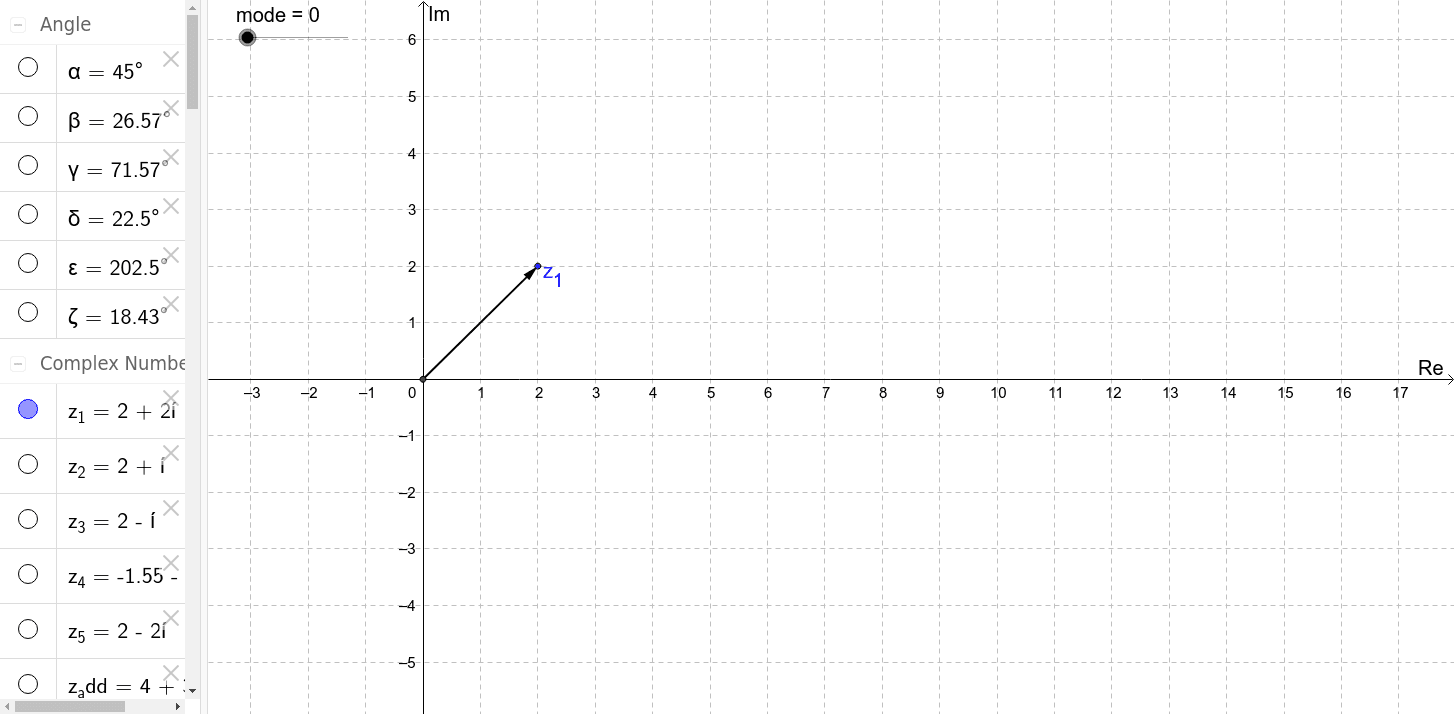
This example demonstrates the geometric interpretation of basic arithmetic operations of complex numbers, including addition, subtraction, multiplication, and division. It involves core concepts such as the algebraic and geometric representation of complex numbers, modulus, argument, and operation rules. Constructed using commands like Point, Intersect, Vector, Segment, Length, Angle, Rotate, Mirror, and objects like z_1, z_2, A, B, etc. Suitable for high school mathematics teaching to help students visually understand the rules of complex number operations.
GeoGebra Commands & Parameters
Point(xAxis) → AIntersect(xAxis, yAxis) → BVector(B, z_1) → uVector(B, z_2) → vVector(B, z_add) → wSegment(z_1, z_add) → aSegment(z_2, z_add) → bVector(B, z_subt) → zSegment(z_2, z_1) → cLength(z_1) → modz_1Length(z_2) → modz_2Point(xAxis) → CAngle(C, B, z_1) → αAngle(C, B, z_2) → βVector(B, z_mult) → dAngle(C, B, z_mult) → γVector(B, z_root) → eAngle(C, B, z_root) → δRotate(z_root, 180*°, B) → z_4Vector(B, z_4) → fAngle(C, B, z_4) → εVector(B, z_div) → gAngle(C, B, z_div) → ζMirror(z_2, xAxis) → z_3Mirror(v, xAxis) → u'Mirror(z_1, xAxis) → z_5Vector(B, z_5) → h
AI Drawing Prompt Reference
Draw a geometric interpretation of basic complex number operations, including two coordinate axes and the origin, with vectors representing two complex numbers, and show their sum, difference, product, and quotient as vectors. Illustrate the geometric meaning of multiplication and division using lengths, angles, line segments, and rotations, and demonstrate the property of complex conjugates through mirror operations.
The prompt above was compiled from the original drawing commands and is for reference only.