
Completing the Square (Part 2): Geometric Construction of a Perfect Square
Loading the math board and drawing, please wait…
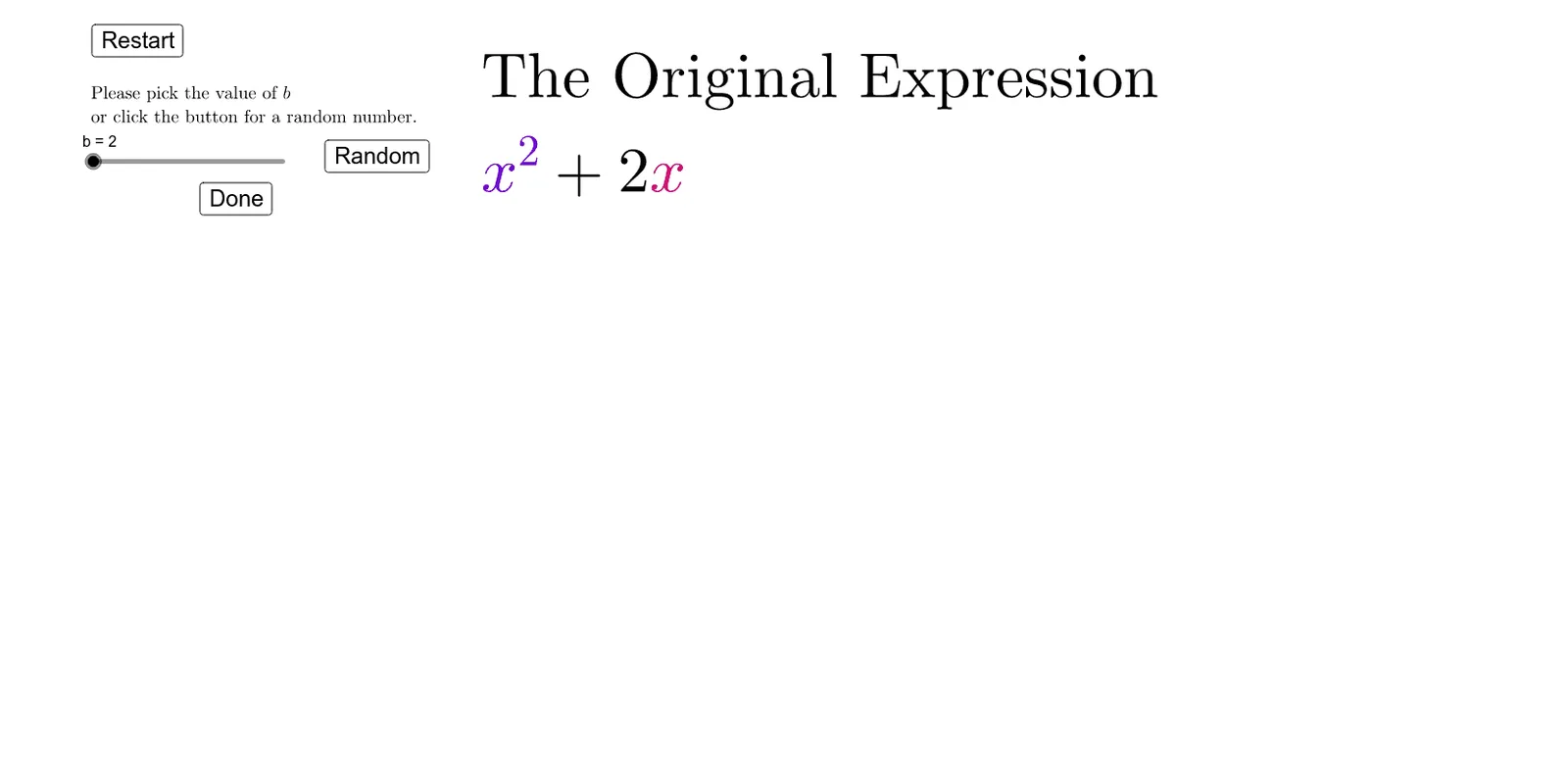
This example demonstrates how to complete the square for a quadratic expression by using a step-by-step geometric construction, making the algebraic transformation visible. It focuses on the key ideas behind completing the square, the vertex (completed-square) form of a quadratic function, and the correspondence between arithmetic/powers in algebra and the matching structure in a constructed figure. Construction-wise, it uses Polygon and Segment to build the geometric pieces and partitions, while Sequence generates ordered points or “steps” to guide the transformation process. Textfield and related text objects are used to input parameters and display coefficients/constants during the demonstration. Multiple function objects (e.g., f, g, h, i) help visualize relationships across stages, and interactive buttons (button1–button7) together with an input box (inputBox1) support an incremental, student-friendly walkthrough. Suitable for middle and high school math learning, especially for teaching quadratic functions and using geometric intuition to justify algebraic identities.
GeoGebra Commands & Parameters
Polygon((0, 0), (x1, 0), (x1, x1), (0, x1)) → Poly1, f, g, h, iSequence(Polygon[(0, x1 - 1 + i), (x1, x1 - 1 + i), (x1, x1 + i), (0, x1 + i)], i, 1, b / 2) → horiSequence(Polygon[(x1 - 1 + i, 0), (x1 + i, 0), (x1 + i, x1), (x1 - 1 + i, x1)], i, 1, b / 2) → vertTextfield(c) → inputBox1Sequence(Sequence[Polygon[(x1 - 1 + i, x1 - 1 + j), (x1 + i, x1 - 1 + j), (x1 + i, x1 + j), (x1 - 1 + i, x1 + j)], i, 1, b / 2], j, 1, b / 2) → addTextfield(fx2) → inputBox2Polygon((0, x1 + b2 / 2), (x1, x1 + b2 / 2), (x1, x1 + b2 / 2 + 0.5), (0, x1 + b2 / 2 + 0.5)) → poly2, j, k, l, mPolygon((x1 + b2 / 2, 0), (x1 + b2 / 2 + 0.5, 0), (x1 + b2 / 2 + 0.5, x1), (x1 + b2 / 2, x1)) → poly3, n, p, q, rSegment((x1, x1 + b1), (x1 + b1, x1 + b1)) → s1Segment((x1 + b1, x1), (x1 + b1, x1 + b1)) → s2
AI Drawing Prompt Reference
Draw a geometric figure consisting of squares and rectangles to demonstrate how to complete a square through step-by-step construction. The figure includes an initial square, and steps to add rectangles and partition lines to gradually expand it. Key objects are squares, rectangles, partition lines, and small rectangles, with their relationships showing the process of building a perfect square. The construction order starts with a basic square, then adds rectangles and partition lines, eventually forming a complete square.
The prompt above was compiled from the original drawing commands and is for reference only.