
Compass Bearing Quiz
Loading the math board and drawing, please wait…
In collections
GCSE Higher Ch8 Transformations & Constructions
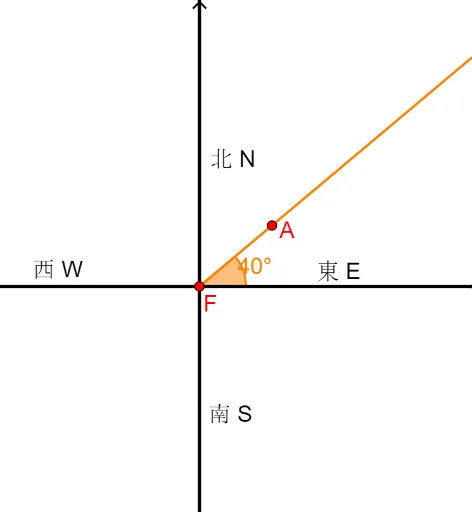
This example demonstrates the calculation and construction of quadrantal angles. It involves core mathematical concepts such as coordinate geometry, angle calculations, vectors, and geometric constructions. GeoGebra commands like Join, RandomElement, If, Ray, Shuffle, Angle, Sequence, Append, SelectedElement, and Element are used in its construction. Suitable for high school mathematics teaching, helping students practice and master the application of quadrantal angles.
GeoGebra Commands & Parameters
Join({Sequence[((i * 5))°, i, 2, 16], Sequence[((i * 5))° + 90°, i, 2, 16], Sequence[((i * 5))° + 180°, i, 2, 16], Sequence[((i * 5))° + 270°, i, 2, 16]}) → listThetaRandomElement(listTheta) → thetaIf(theta < 90°, {N, E}, If[theta < 180°, {N, W}, If[theta < 270°, {W, S}, {S, E}]]) → listTwoPointRay(A, B) → cIf(theta < 180°, "N", "S") → ans1If(theta > 90° ∧ theta < 270°, "W", "E") → ans2If(theta < 90°, 90° - theta, If[theta < 180°, theta - 90°, If[theta < 270°, 270° - theta, theta - 270°]]) → ans3Shuffle({"A", "B", "C", "D", "F", "G", "H", "J", "K", "L", "M", "P", "Q", "R", "T", "U", "V", "X", "Y", "Z"}) → listLetterRandomElement(listTwoPoint) → CAngle(C, A, B) → angleShownSequence(Text[((i * 5))°], i, 0, 71) → list1Append("?", Zip[If[Length[k] ≟ 2, "00", If[Length[k] ≟ 3, "0", ""]] + (k), k, list1]) → listBearingSelectedElement(listBearing) → inputAngle(B, A, N) → angleAnsElement(listBearing, angleAns / (5°) + 2) → Answer
AI Drawing Prompt Reference
Draw a coordinate system with multiple 5-degree angle markers, showing rays extending from north, east, south, and west, randomly select an angle and label its direction, display the supplement of the angle, randomly choose an angle from the sequence as input, and finally show the correct answer.
The prompt above was compiled from the original drawing commands and is for reference only.