
Comparing Probability Outcomes With and Without Replacement
Loading the math board and drawing, please wait…
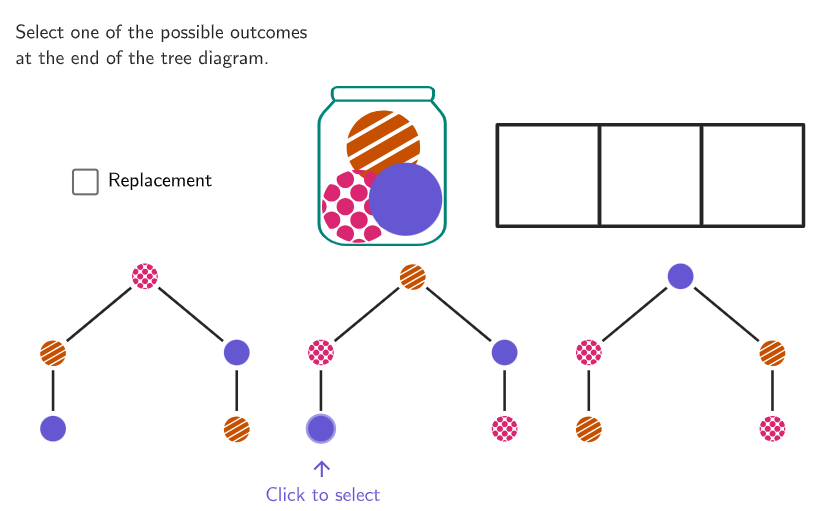
This example demonstrates how compound probabilities differ with or without replacement using a tree diagram. It involves core math concepts like probability calculation, compound events, and conditional probability. The construction utilizes GeoGebra commands such as Corner, Sequence, Flatten, Zip, Dilate, Translate, Polygon, If, etc., to build the tree diagram and show different probability paths under various conditions. Suitable for students in grades 6-8 learning to determine the probability of compound events with and without replacement.
GeoGebra Commands & Parameters
Corner(5) → AppSizeSequence(((ii * 5.25), 2), ii, 0, 2) → IniPointsFlatten(Zip[{Segment[PP, PP - (sep1, 1.5)], Segment[PP, PP - (0, 1.5)], Segment[PP, PP - ((-sep1), 1.5)]}, PP, IniPoints]) → segsAboveZip(Vertex[SS, 2], SS, segsAbove) → MidPointsFlatten(Zip[{Segment[PP, PP - (sep2, 1.5)], Segment[PP, PP - (0, 1.5)], Segment[PP, PP - ((-sep2), 1.5)]}, PP, MidPoints]) → segsBelowZip(Vertex[SS, 2], SS, segsBelow) → EndPointsFlatten(Zip[{Segment[PP, PP - (sep1, 1.5)], Segment[PP, PP - ((-sep1), 1.5)]}, PP, IniPoints]) → segsAboveNRZip(Vertex[SS, 2], SS, segsAboveNR) → MidPointsNRZip(Segment[PP, PP - (0, 1.5)], PP, MidPointsNR) → segsBelowNRZip(Vertex[SS, 2], SS, segsBelowNR) → EndPointsNRZip({PP - (sep2 / 2, sep2 / 2), PP - (((-sep2)) / 2, sep2 / 2)}, PP, EndPoints) → m1Dilate(pic1, 0.35, A) → pic1smallTranslate(pic1small, Vector[A, EndPoints(1)]) → pic1B11Translate(pic1small, Vector[A, EndPoints(4)]) → pic1B12Translate(pic1small, Vector[A, EndPoints(7)]) → pic1B13Translate(pic1small, Vector[A, EndPoints(10)]) → pic1B21Translate(pic1small, Vector[A, EndPoints(13)]) → pic1B22Translate(pic1small, Vector[A, EndPoints(16)]) → pic1B23Translate(pic1small, Vector[A, EndPoints(19)]) → pic1B31Translate(pic1small, Vector[A, EndPoints(22)]) → pic1B32Translate(pic1small, Vector[A, EndPoints(25)]) → pic1B33Dilate(pic2, 0.35, B) → pic2smallTranslate(pic2small, Vector[B, EndPoints(2)]) → pic2B11Translate(pic2small, Vector[B, EndPoints(5)]) → pic2B12Translate(pic2small, Vector[B, EndPoints(8)]) → pic2B13Translate(pic2small, Vector[B, EndPoints(11)]) → pic2B21Translate(pic2small, Vector[B, EndPoints(14)]) → pic2B22Translate(pic2small, Vector[B, EndPoints(17)]) → pic2B23Translate(pic2small, Vector[B, EndPoints(20)]) → pic2B31Translate(pic2small, Vector[B, EndPoints(23)]) → pic2B32Translate(pic2small, Vector[B, EndPoints(26)]) → pic2B33Dilate(pic3, 0.35, C) → pic3smallTranslate(pic3small, Vector[C, EndPoints(3)]) → pic3B11Translate(pic3small, Vector[C, EndPoints(6)]) → pic3B12Translate(pic3small, Vector[C, EndPoints(9)]) → pic3B13Translate(pic3small, Vector[C, EndPoints(12)]) → pic3B21Translate(pic3small, Vector[C, EndPoints(15)]) → pic3B22Translate(pic3small, Vector[C, EndPoints(18)]) → pic3B23Translate(pic3small, Vector[C, EndPoints(21)]) → pic3B31Translate(pic3small, Vector[C, EndPoints(24)]) → pic3B32Translate(pic3small, Vector[C, EndPoints(27)]) → pic3B33Translate(pic3small, Vector[C, MidPoints(3)]) → pic3M1Translate(pic3small, Vector[C, MidPoints(6)]) → pic3M2Translate(pic3small, Vector[C, MidPoints(9)]) → pic3M3Translate(pic2small, Vector[B, MidPoints(2)]) → pic2M1Translate(pic2small, Vector[B, MidPoints(5)]) → pic2M2Translate(pic2small, Vector[B, MidPoints(8)]) → pic2M3Translate(pic1small, Vector[A, MidPoints(1)]) → pic1M1Translate(pic1small, Vector[A, MidPoints(4)]) → pic1M2Translate(pic1small, Vector[A, MidPoints(7)]) → pic1M3Translate(pic1small, Vector[A, IniPoints(1)]) → pic1TTranslate(pic2small, Vector[B, IniPoints(2)]) → pic2TTranslate(pic3small, Vector[C, IniPoints(3)]) → pic3TZip(Circle[PP, 0.35], PP, IniPoints) → l1Zip(Circle[PP, 0.35], PP, If[repYESNO, MidPoints, MidPointsNR]) → l2Zip(Circle[PP, 0.35], PP, If[repYESNO, EndPoints, EndPointsNR]) → l3Translate(pic1small, Vector[A, MidPointsNR(3)]) → pic1M2NRTranslate(pic1small, Vector[A, MidPointsNR(5)]) → pic1M3NRTranslate(pic2small, Vector[B, MidPointsNR(1)]) → pic2M1NRTranslate(pic2small, Vector[B, MidPointsNR(6)]) → pic2M3NRTranslate(pic3small, Vector[C, MidPointsNR(2)]) → pic3M1NRTranslate(pic3small, Vector[C, MidPointsNR(4)]) → pic3M2NRTranslate(pic3small, Vector[C, EndPointsNR(1)]) → pic3B11NRTranslate(pic3small, Vector[C, EndPointsNR(3)]) → pic3B21NRTranslate(pic2small, Vector[B, EndPointsNR(2)]) → pic2B12NRTranslate(pic2small, Vector[B, EndPointsNR(5)]) → pic2B31NRTranslate(pic1small, Vector[A, EndPointsNR(4)]) → pic1B22NRTranslate(pic1small, Vector[A, EndPointsNR(6)]) → pic1B32NRPolygon({D, D + (2, 0), D + (2, 2), D + (0, 2)}) → q1Translate(q1, (2, 0)) → q2Translate(q1, (4, 0)) → q3Translate(pic1, Vector[CP11, D]) → pic1T1Translate(pic1, Vector[CP11, Vertex[q2, 1]]) → pic1T2Translate(pic1, Vector[CP11, Vertex[q3, 1]]) → pic1T3Translate(pic2, Vector[CP21, D]) → pic2T1Translate(pic2, Vector[CP21, Vertex[q2, 1]]) → pic2T2Translate(pic2, Vector[CP21, Vertex[q3, 1]]) → pic2T3Translate(pic3, Vector[CP31, Vertex[q3, 1]]) → pic3T3Translate(pic3, Vector[CP31, Vertex[q2, 1]]) → pic3T2Translate(pic3, Vector[CP31, D]) → pic3T1If(repYESNO, g(anim), anim - floor(anim)) → timeTranslate(pic1, Vector[CP11, PAnim1]) → pic1'Translate(pic2, Vector[CP21, PAnim2]) → pic2'Translate(pic3, Vector[CP31, PAnim3]) → pic3'If(repYESNO, 1 / 2, 1) → speedTranslate(Element[{pic1small, pic2small, pic3small}, orderAnim(1)], Vector[Element[{A, B, C}, orderAnim(1)], E]) → pic4Translate(Element[{pic1small, pic2small, pic3small}, orderAnim(2)], Vector[Element[{A, B, C}, orderAnim(2)], F]) → pic5Translate(Element[{pic1small, pic2small, pic3small}, orderAnim(3)], Vector[Element[{A, B, C}, orderAnim(3)], G]) → pic6If(repYESNO, index3R, index3NR) → index3If(repYESNO, index2R, index2NR) → index2If(repYESNO, segsAbove(index2), segsAboveNR(index2)) → fIf(repYESNO, segsBelow(index3), segsBelowNR(index3)) → hIf(repYESNO, 328, 301) → onboardingX_{1}onboardingTextOffset(Corner[onboardingText_{1}, 1], Corner[onboardingText_{1}, 3], onboardingCase_{1}, Corner[1], Corner[3], Corner[5]) → OnboardingTextOffset_{1}If(repYESNO, EndPoints(12), EndPointsNR(3)) → InputPointcirclePixels(InputPoint, 12 + (7 * pulsing), Cor1, Cor3, (800, 500)) → pulsingObjectCircle(Center1, 0.75) → CircleWhite1Circle(Center2, 0.75) → CircleWhite2Circle(Center3, 0.75) → CircleWhite3
AI Drawing Prompt Reference
Draw a probability tree diagram comparing outcomes with and without replacement. The diagram should include multiple nodes and connected lines, with nodes arranged from top to bottom. Lines represent the sequence of events. Construct by first creating the root node, then adding child nodes, and finally connecting the lines to clearly show different probability paths.
The prompt above was compiled from the original drawing commands and is for reference only.