
Compare Shapes
Loading the math board and drawing, please wait…
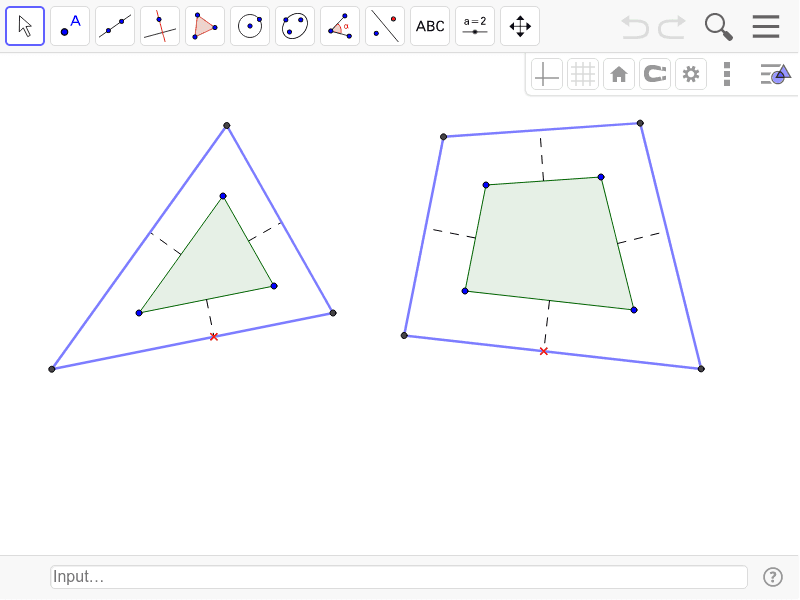
This example demonstrates the concept of similar figures. By using transformations such as dilation and rotation, you can observe the properties of similar figures. The construction involves commands like Polygon, Midpoint, Segment, etc. Suitable for middle school and above students learning geometric transformations.
GeoGebra Commands & Parameters
Polygon(A, B, C) → poly1, c, a, bMidpoint(a) → DMidpoint(b) → EMidpoint(c) → FSegment(F, C) → dSegment(E, B) → eIntersect(d, e) → GMirror(G, a) → G'Line(G', a) → fOrthogonalLine(D, a) → gIntersect(g, f) → HRay(D, H) → hPoint(h) → ILine(I, a) → iSegment(D, I) → jOrthogonalLine(F, c) → kOrthogonalLine(E, b) → lCircle(F, j) → pCircle(E, j) → qIntersect(p, k, 1) → JIntersect(q, l, 1) → KLine(J, c) → mLine(K, b) → nIntersect(m, n) → LIntersect(i, n) → MIntersect(i, m) → NSegment(F, J) → rSegment(E, K) → sPolygon(L, N, M) → poly2, m_1, l_1, n_1Polygon(O, P, Q, R) → poly3, o, p_1, q_1, r_1Segment(R, P) → tSegment(O, Q) → a_1Intersect(t, a_1) → SMidpoint(p_1) → TMidpoint(q_1) → UMidpoint(r_1) → VMidpoint(o) → WMirror(S, p_1) → S'Line(S', p_1) → b_1OrthogonalLine(T, b_1) → c_1Intersect(b_1, c_1) → ZRay(T, Z) → d_1Point(d_1) → A_1Line(A_1, p_1) → e_1Segment(T, A_1) → f_1OrthogonalLine(W, o) → g_1Circle(W, f_1) → h_1Intersect(h_1, g_1, 1) → B_1Line(B_1, o) → i_1Segment(W, B_1) → j_1Intersect(e_1, i_1) → C_1OrthogonalLine(V, r_1) → k_1Circle(V, f_1) → s_1Intersect(s_1, k_1, 1) → D_1Line(D_1, r_1) → t_1Segment(V, D_1) → a_2Intersect(i_1, t_1) → E_1OrthogonalLine(U, q_1) → b_2Circle(U, f_1) → c_2Intersect(c_2, b_2, 1) → F_1Line(F_1, q_1) → d_2Segment(U, F_1) → e_2Intersect(t_1, d_2) → G_1Intersect(e_1, d_2) → H_1Polygon(E_1, C_1, H_1, G_1) → poly4, e_3, c_3, h_2, g_2
AI Drawing Prompt Reference
Draw two similar triangles. First, draw triangle ABC. Then, use midpoints D, E, and F to construct segments and mirrors. Next, use perpendicular lines and circles to find corresponding points for the similar triangle. Finally, use mirrors and perpendicular lines to construct the second triangle, ensuring both triangles are similar.
The prompt above was compiled from the original drawing commands and is for reference only.