
Common Notion 3: Circle through Three Points with Tangents and Reflections
Loading the math board and drawing, please wait…
In collections
Basic Constructions
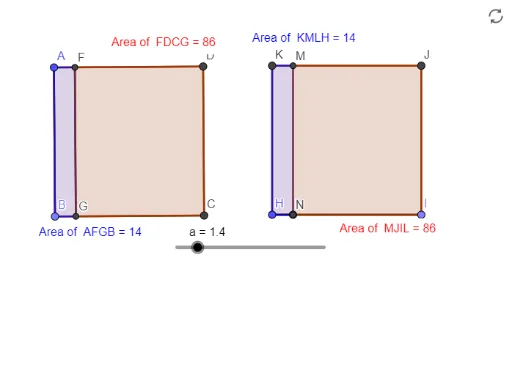
This GeoGebra example demonstrates the construction of a circle passing through three non-collinear points, along with tangent lines, perpendiculars, and reflections, to visually verify the classical geometric axiom that exactly one circle passes through any three non-collinear points. Core mathematical concepts include the uniqueness of a circumcircle, tangent line properties, reflection transformations, and the interplay of polygons and function graphs. The construction uses commands such as Point, Segment, Polygon, OrthogonalLine, Intersect, and PointIn, with objects including points A, B, C, polygon poly1, lines g, h, i, j, circles q1 and q2, tangents a_1 and f_1, and text labels Textq1. Suitable for high school geometry or introductory college geometry courses, this example helps students understand circle determination and geometric construction techniques.
GeoGebra Commands & Parameters
Point(Circle[A, 10]) → BSegment(A, B) → fPolygon(A, B, 4) → poly1, g, h, i, j, C, DPoint(Circle[B, a]) → ESegment(B, E) → kOrthogonalLine(E, h) → lIntersect(l, j) → FIntersect(l, h) → GSegment(F, E) → mPolygon(A, F, G, B) → q1, a_1, f_1, g_1, bPointIn(poly1) → Pointpoly1PointIn(q1) → Pointq1Polygon(F, D, C, G) → q2, f_2, d, c, g_2PointIn(q2) → Pointq2_1Point(Circle[H, 10]) → ISegment(H, I) → nPolygon(H, I, 4) → poly2, p, q, r, s, J, KPoint(Circle[H, a]) → LSegment(H, L) → tOrthogonalLine(L, n) → eIntersect(e, r) → MIntersect(e, n) → NPolygon(K, M, L, H) → q3, k_1, m_1, l_1, h_1Polygon(M, J, I, L) → q4, m_2, j_1, i_1, l_2PointIn(q3) → Pointq3_1PointIn(q4) → Pointq4PointIn(q3) → Pointq3PointIn(q2) → Pointq2
AI Drawing Prompt Reference
Draw a circle passing through three points A, B, and C, and then draw the tangents a_1 and f_1 to this circle. Construct a quadrilateral ABCD, and then draw another circle and quadrilateral through points B and C. Finally, draw the tangents and reflections of these circles to form a series of geometric shapes.
The prompt above was compiled from the original drawing commands and is for reference only.