
Combinations of Three Vectors and Plane Construction
Loading the math board and drawing, please wait…
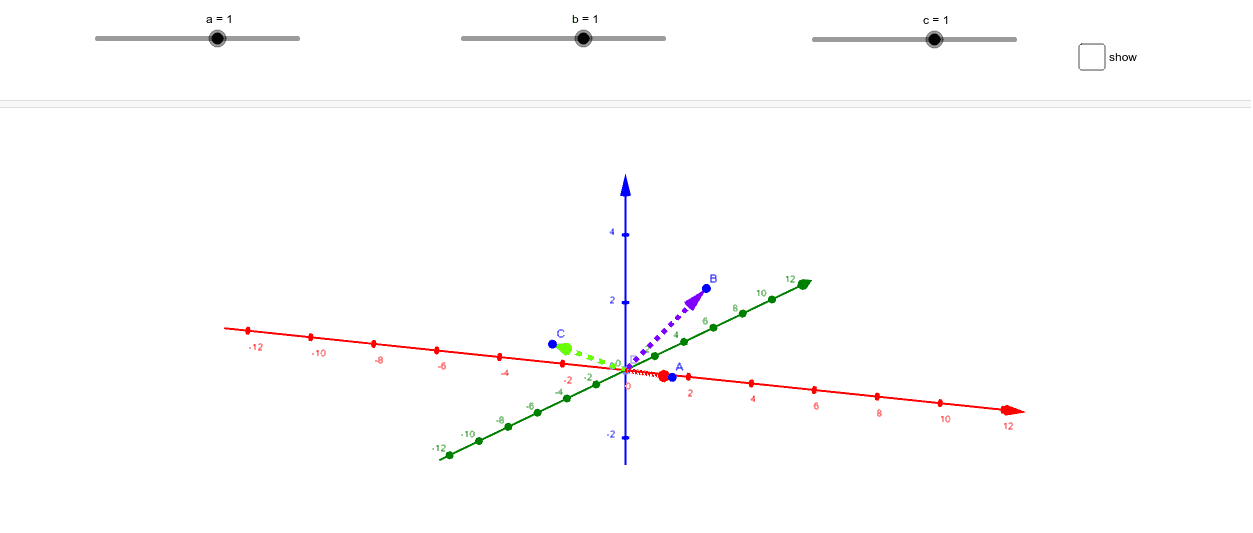
This GeoGebra example demonstrates how three vectors u, v, and w can be combined linearly to generate points, segments, and a plane, while auxiliary points A through I form related polygonal structures. It highlights vector addition, scalar multiplication, linear combinations, coplanarity, plane representation, and coordinate relationships in space. The construction uses the Vector command to define vectors and the Plane command to determine a plane from points or vectors, with objects such as A, B, C, D, E, F, G, H, I, u, v, w, a, b, and c linking the geometric configuration. It is suitable for high school vector geometry, introductory linear algebra, or coordinate geometry lessons where students explore how vector combinations determine planes and spatial figures.
GeoGebra Commands & Parameters
Vector(D, B) → uVector(D, A) → vVector(D, C) → wVector(D, E) → dVector(E, G) → eVector(E, F) → fVector(F, H) → gVector(F, I) → hPlane(I, F, E) → i
AI Drawing Prompt Reference
This is a geometric figure consisting of three vectors u, v, w and auxiliary points A through I. The vectors u, v, w originate from point D and point to B, A, C respectively. Plane i is defined by points I, F, E. The auxiliary points A, B, C, D, E, F, G, H, I form related polygonal structures. This figure illustrates vector linear combinations, plane representation, and spatial coordinate relationships, suitable for high school vector geometry or introductory linear algebra courses.
The prompt above was compiled from the original drawing commands and is for reference only.