
Clock Manipulative
Loading the math board and drawing, please wait…
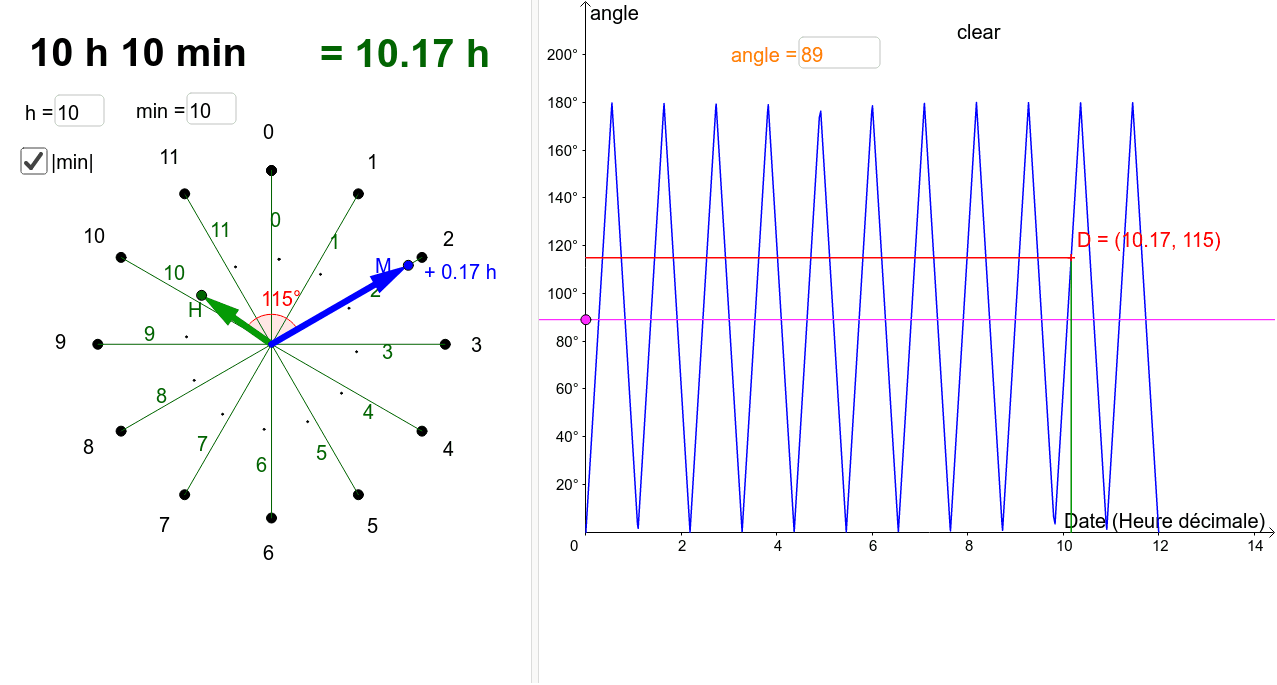
This example dynamically demonstrates the movement of clock hands, illustrating the relationship between angles and linear functions. It involves core math concepts like angles, linear functions, sequences, trigonometric functions, and interest calculation. Construction highlights the use of commands such as Vector, Angle, Sequence, Point, OrthogonalLine, Textfield, and Segment in GeoGebra. Suitable for high school mathematics education to understand the mathematical principles behind clock motion.
GeoGebra Commands & Parameters
Vector(H) → uVector(M) → vAngle(M, (0, 0), (0, 1)) → mSequence((((1.1 * k) * sin(i)), ((1.1 * k) * cos(i))), i, 0, 6.28319, 0.5236) → liste1Sequence((sin(i + m / 12), cos(i + m / 12)), i, 0, 6.28319, 0.5236) → listeHAngle(H, (0, 0), (0, 1)) → hAngle(M, (0, 0), H) → αSequence(((k * sin(i)), (k * cos(i))), i, 0, 6.28319, 0.10471975511965977) → listeMPoint(yAxis) → AOrthogonalLine(A, yAxis) → bTextfield(an) → ChampTexte1Textfield(rh) → ChampTexte2Textfield(rm) → ChampTexte3Sequence(Text[i - 1, Element[liste1, i] + ((0.4 * sin(((i - 1) * π / 6))) - 0.1, (0.4 * cos(((i - 1) * π / 6))) - (0.1 * sin((i * π / 12))))], i, 1, 12) → listeTxtSequence(Text[i - 1, Element[listeH, i] + ((0.4 * sin(((i - 1) * π / 6))) - 0.1, (0.4 * cos(((i - 1) * π / 6))) - (0.1 * sin((i * π / 12))))], i, 1, 12) → listeTHSegment(D, (0, y(D))) → cSegment(D, (x(D), 0)) → dSequence(Segment[(0, 0), Element[liste1, i]], i, 1, 12) → liste2