
Classifying Rational Numbers by Levi J Guter
Loading the math board and drawing, please wait…
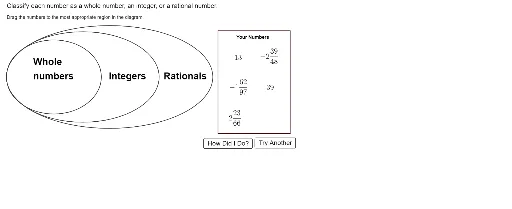
This example demonstrates the classification of rational numbers through dynamic geometry and interactive operations. It involves core math concepts like rational number definitions, classification criteria, geometric representation, and probability statistics. Construction highlights include commands like Segment, Circle, Random, Sum, Text, Polygon, and objects such as points, circles, and polygons, creating visual models. Suitable for high school mathematics teaching to understand rational number properties and probability applications.
GeoGebra Commands & Parameters
Segment(center, point1) → SegRad1Circle(center, CircRad3) → circle3Circle(center, CircRad2) → circle2Circle(center, CircRad1) → circle1Random(0, 99) → RandNum1Random(0, 99) → RandNum2Random(1, 3) → diceroll1Circle(point1, 1) → HidePoint1Random(1, 9) → RandNum3Random(1, 2) → dicerollnegativeCircle(point2, 1) → HidePoint2Sum({count1, count2, count3, count4, count5}) → HelperFunction1Random(1, 3) → diceroll2Random(1, 3) → diceroll3Random(1, 3) → diceroll4Random(1, 3) → diceroll5Segment(center, point2) → SegRad2Segment(center, point3) → SegRad3Segment(center, point4) → SegRad4Segment(center, point5) → SegRad5Circle(point3, 1) → HidePoint3Circle(point4, 1) → HidePoint4Circle(point5, 1) → HidePoint5Circle(center, CircRad1) → circleshade1Circle(center, CircRad2) → circleshade2Circle(center, CircRad3) → circleshade3Circle((16, 2), 1.2) → startcircle2Circle((16, -1), 1.2) → startcircle3Circle((16, -4), 1.2) → startcircle4Circle((19, 2), 1.2) → startcircle1Circle((19, -1), 1.2) → startcircle5Text("Drag the numbers to the most appropriate region in the diagram.") → InstText("Your Numbers") → text4Polygon(A, B, C, D) → poly1, a, b, c, dText("Classify each number as a whole number, an integer, or a rational number.") → GenInstructions
AI Drawing Prompt Reference
Create a geometric diagram to demonstrate the classification of rational numbers, featuring three concentric circles and a central point, with different-sized circles representing various ranges of rational numbers, and classifying randomly generated numbers. Start with a central point and draw three concentric circles of increasing sizes, connect the center to randomly generated points while hiding some, shade the circles in different colors to indicate distinct rational number regions, and add text instructions on how to classify the numbers.
The prompt above was compiled from the original drawing commands and is for reference only.