
Classifying Polygons
Loading the math board and drawing, please wait…
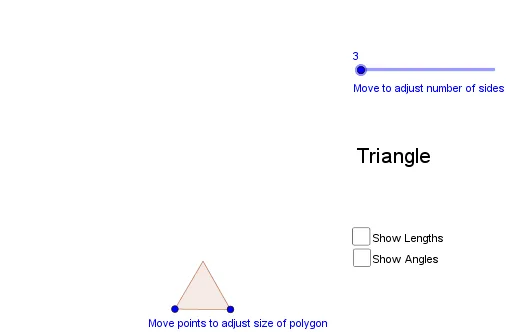
This example demonstrates how to classify polygons based on their angles and side lengths. Key mathematical concepts include properties of polygons, angle measurement, and side length relationships. Using GeoGebra commands such as Polygon and Angle, you can dynamically adjust the shape and size of the polygon to observe its changes. Suitable for middle school and above students and teachers.
GeoGebra Commands & Parameters
Polygon(A, B, a) → poly1, f, p, q, r, s, t, C, D, E, F, G, g, H, I, J, K, L, M, N, h, i, j, k, l, m, nAngle(A, E, D) → αAngle(E, D, C) → βAngle(D, C, B) → γAngle(C, B, A) → δAngle(B, A, E) → εAngle(A, D, C) → ζAngle(B, A, D) → ηAngle(A, C, B) → θAngle(B, A, C) → ιAngle(B, A, F) → κAngle(A, F, E) → λAngle(F, E, D) → μAngle(B, A, G) → νAngle(A, G, F) → ξAngle(G, F, E) → οAngle(B, A, H) → ρAngle(A, H, G) → σAngle(H, G, F) → τAngle(B, A, I) → υAngle(A, I, H) → ϕAngle(I, H, G) → χAngle(B, A, J) → ψAngle(A, J, I) → ωAngle(J, I, H) → α_1Angle(B, A, K) → β_1Angle(A, K, J) → γ_1Angle(K, J, I) → δ_1Angle(B, A, L) → ε_1Angle(A, L, K) → ζ_1Angle(L, K, J) → η_1Angle(B, A, M) → θ_1Angle(A, M, L) → ι_1Angle(M, L, K) → κ_1Angle(B, A, N) → λ_1Angle(A, N, M) → μ_1Angle(N, M, L) → ν_1
AI Drawing Prompt Reference
Draw a hexagon ABCDEF and measure and display the degree of each interior angle to observe how angle changes affect the shape of the hexagon. First, draw vertices A, B, C, D, E, and F, then connect these points to form the hexagon, and finally measure and display the degree of each interior angle.
The prompt above was compiled from the original drawing commands and is for reference only.