
Circumference of a Circle using 'i' (Riemann Sum & Derivative)
Loading the math board and drawing, please wait…
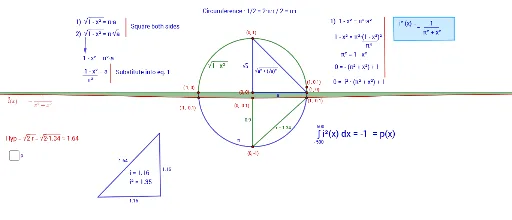
① This GeoGebra example dynamically demonstrates how the circumference of a circle can be approximated by summing small straight segments indexed by the natural number 'i', visually connecting to the concept of π. ② Core mathematical concepts include circle circumference, upper and lower Riemann sums, derivative intuition, limits, natural numbers, and angles. ③ Construction highlights: using GeoGebra commands such as Point, Semicircle, Mirror, Segment, Intersect, Vector, Polygon, and Integral, the applet builds multiple objects (A, B, c, c', f, text1, etc.) and uses a slider or parameter to increase the number of subdivisions, refining the approximation. ④ Suitable for high school or early college students to explore the fundamental ideas of calculus (approximation, limits) and to investigate the value of π interactively.
GeoGebra Commands & Parameters
Point(xAxis) → APoint(xAxis) → BSemicircle(A, B) → cMirror(c, xAxis) → c'Segment(C, D) → gSegment(G, B) → aSegment(G, E) → i_1Segment(E, B) → hSegment(H, I) → jIntersect(i, yAxis, (0, -0.10132118364233777)) → JSegment(J, F) → kPoint(c') → KSegment(K, F) → lSegment(L, M) → mSegment(N, O) → nSegment(P, Q) → p_5Segment(P_1, Q_1) → p_1Vector(R, S) → uSegment(P_2, Q_2) → p_2Segment(T, U) → qSegment(P_3, Q_3) → p_3Segment(V, W) → rSegment(P_4, Q_4) → p_4Polygon(Z, A_1, B_1, C_1) → q1, z_1, a_1, b_1, c_1Segment(T_1, U_1) → q_1Point(Circle[D_1, 1.64]) → E_1Segment(D_1, E_1) → sPoint(Circle[E_1, 1.16]) → F_1Segment(E_1, F_1) → tPoint(Circle[D_1, 1.16]) → G_1Segment(D_1, G_1) → bIntegral(i, -500, 500) → dPoint(c') → H_1