
Circle-Inscribed Quadrilateral and Similar Triangles
Loading the math board and drawing, please wait…
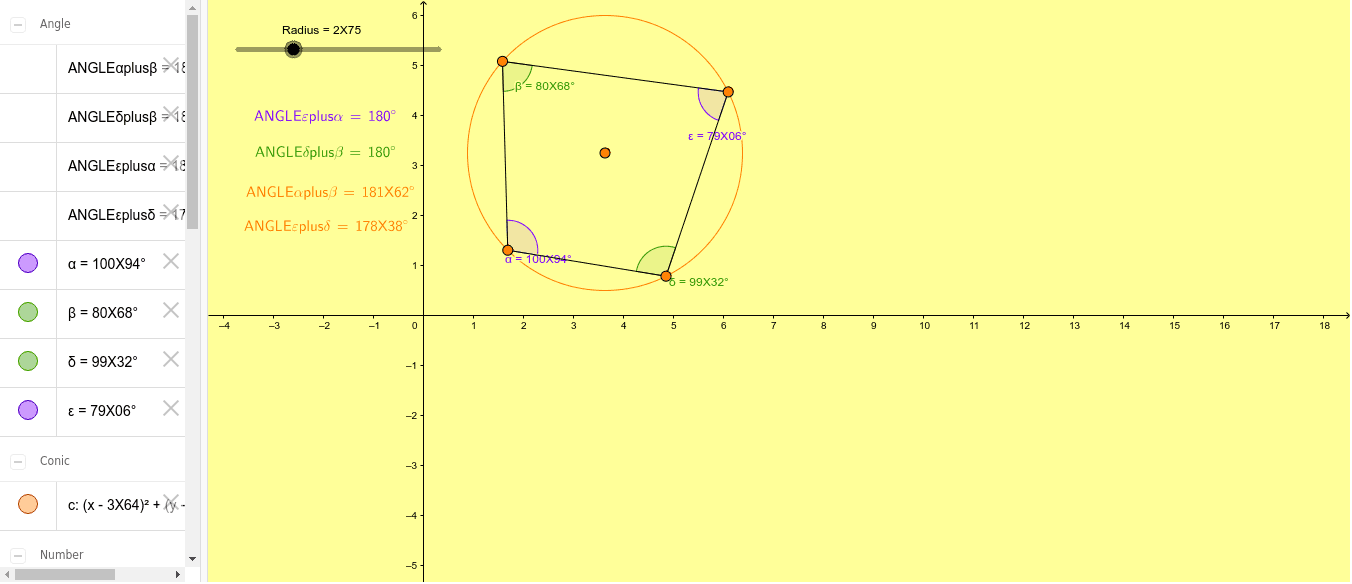
This example demonstrates the similar triangles formed within a cyclic quadrilateral, highlighting the complementary opposite angles and equal corresponding angles. Core mathematical concepts include cyclic quadrilaterals, similar triangles, the inscribed angle theorem, angle relationships, and geometric proof. Construction details: using GeoGebra commands such as Circle to draw the circumcircle, Point to place four points A, B, C, D on the circle, Segment to connect sides and diagonals, Angle to label angles α, β, ε, δ, and LaTeX text objects to display angle sums like ∠ε+∠α and ∠δ+∠β. By dragging points, learners can observe that angle sums remain constant, reinforcing the cyclic quadrilateral property. Suitable for middle and high school geometry classes, this interactive tool helps students explore similarity criteria and circle theorems, and serves as an engaging introduction to dynamic geometric reasoning.
GeoGebra Commands & Parameters
Circle(A, Radius) → cPoint(c) → BPoint(c) → CPoint(c) → DPoint(c) → ESegment(B, C) → fSegment(C, D) → gSegment(D, E) → hSegment(E, B) → iAngle(E, B, C) → αAngle(B, C, D) → βAngle(C, D, E) → εAngle(D, E, B) → δLaTeX(ANGLEεplusα, true, true) → text1LaTeX(ANGLEδplusβ, true, true) → text2LaTeX(ANGLEαplusβ, true, true) → text3LaTeX(ANGLEεplusδ, true, true) → text4