
Chladni Plate Animation
Loading the math board and drawing, please wait…
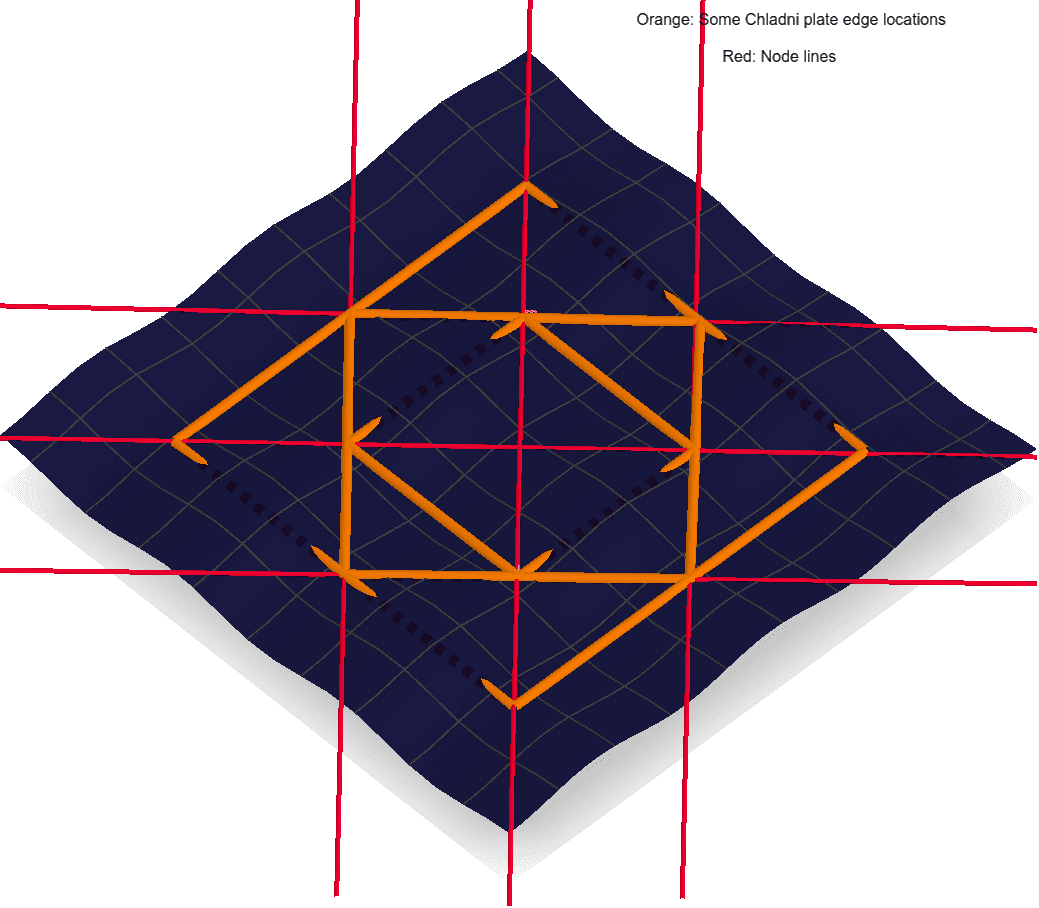
This example demonstrates the physical phenomenon of Chladni plates, showing dynamic trajectories of vibrating objects. Core mathematical concepts include surface, ellipse, congruence, unit circle, pie chart or circle chart, and coordinate geometry. Construction highlights involve commands like Line, PointIn, Intersect, Mirror, Point, and Segment from GeoGebra, as per the summary. Suitable for high school physics and mathematics education to understand the mathematical representation of vibrations and waveforms.
GeoGebra Commands & Parameters
Line(G, H) → iLine(F, E) → kLine(D, B) → gLine(I, J) → jPointIn(f) → OLine(L, O) → hIntersect(j, i) → PIntersect(j, k) → QLine(P, Q) → lMirror(P, L) → P'Mirror(Q, O) → Q'Line(P', Q') → mPoint(m) → NPoint(l) → RSegment(R, O) → pSegment(O, N) → qSegment(N, L) → rSegment(L, R) → sSegment(Q', J) → nSegment(J, P) → tSegment(P, P') → bSegment(P', Q') → cSegment(T, U) → dSegment(U, M) → eSegment(M, S) → f_1Segment(S, T) → g_1
AI Drawing Prompt Reference
Draw the dynamic trajectories of vibrating objects, showing waveforms and paths with an ellipse and unit circle, including multiple mirrored lines and points. Start by drawing several reference lines, find intersection points of lines, mirror and connect these points to generate geometric shapes, and finally connect these points with line segments to form closed figures, demonstrating the dynamic effect of vibrations.
The prompt above was compiled from the original drawing commands and is for reference only.