
CCGPS AA 4.2.3 Example 3: Simplifying a Logarithmic Function Using Log Propertie
Loading the math board and drawing, please wait…
In collections
CCGPS AA Unit 4 Lesson 2
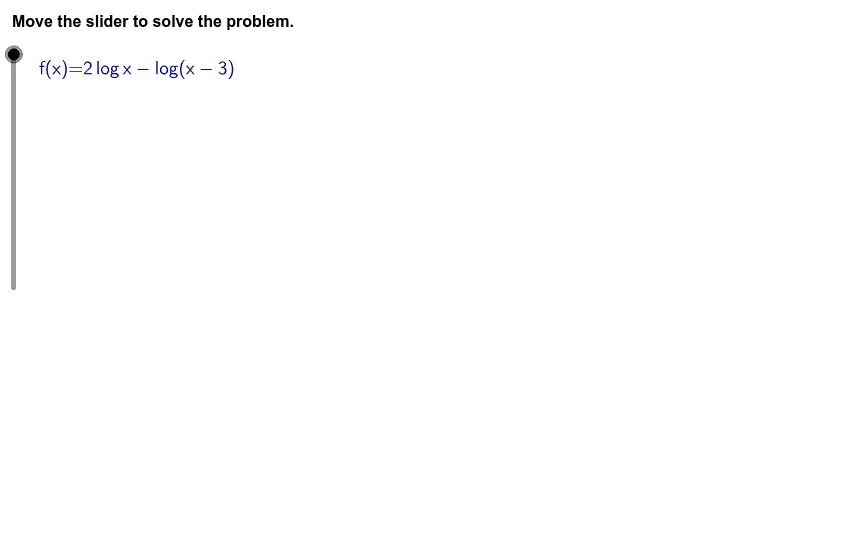
① This example interactively demonstrates how to simplify the logarithmic function f(x)=2 log_x – log_(x–3) by applying logarithm properties step by step. ② Core concepts include the product, quotient, and power rules of logarithms, domain considerations, and algebraic manipulation of log expressions. ③ Construction highlights: GeoGebra commands Sequence, If, LaTeX, Text, TableText; objects such as sliders (step, stepmax, stepper), logpropertywords, addsubtractwords, logquot, logprod, logprop, logdivmult, simpdivmult, and button controls guide users through the simplification process. ④ Designed for high‑school algebra students (grades 10‑12) and teachers creating interactive lessons on logarithmic functions.
GeoGebra Commands & Parameters
Sequence(x = a, a, -7, -5, 0.5) → alignIf(const2 < 0, "-", "+") → pmLaTeX((((("\text{x} {" * pm) * "} {") * abs(const2)) * "}")) → expressionLaTeX((((("\textcolor{#000099}{\text{f(x)=}{" * e) * "}\log{x}-\log{\left(") * expression) * "\right)}}")) → divtextLaTeX((((("\textcolor{#000099}{\text{f(x)=}{" * e) * "}\log{x}+\log{\left(") * expression) * "\right)}}")) → multtextIf(divormult ≟ 1, divtext, multtext) → divmultLaTeX("\text{Identify which logarithmic properties can be used to simplify the}\cr \text{logarithmic function.}") → text2If(divormult ≟ 1, LaTeX["\textcolor{#000099}\text{Quotient Property of Logarithms}"], LaTeX["\textcolor{#000099}\text{Product Property of Logarithms}"]) → logpropertywordsIf(divormult ≟ 1, "subtraction", "addition") → addsubtractwordsLaTeX("\textcolor{#000099}{\log_{a}{\left(\frac{x}{y} \right)}=\log_{a}{x} - \log_{a}{y}}") → logquotLaTeX("\textcolor{#000099}{\log_{a}{\left(xy \right)}=\log_{a}{x} + \log_{a}{y}}") → logprodIf(divormult ≟ 1, logquot, logprod) → logpropLaTeX((((((("\text{Additionally, this function includes the }{" * addsubtractwords) * "}\text{ of two logarithmic}\cr \text{terms. This form is also seen in the }{") * logpropertywords) * "}\text{,}\cr\text{where }{") * logprop) * "}\text{.}")) → text4LaTeX("\text{Simplify the logarithmic function by applying the identified properties.}") → text6If(divormult ≟ 1, LaTeX[(((("\textcolor{#000099}{f(x)=\left(\log{x^{" * e) * "}}\right) - \log \left({") * expression) * "}\right) }")], LaTeX[(((("\textcolor{#000099}{f(x)=\left(\log{x^{" * e) * "}}\right) + \log \left({") * expression) * "}\right) }")]) → logdivmultIf(divormult ≟ 1, LaTeX[(((("\textcolor{#000099}{f(x)=\log \left(\frac{x^{" * e) * "}}{{") * expression) * "}}\right)}")], LaTeX[(((("\textcolor{#000099}{f(x)=\log \left(x^{" * e) * "}\left({") * expression) * "}\right)\right)}")]) → simpdivmultLaTeX((((("\text{The logarithmic function }{" * divmult) * "}\cr \text{simplifies to }{") * simpdivmult) * "}\text{.}")) → text12LaTeX((("\textcolor{#000099}{" * divmult) * "}")) → text1LaTeX("\text{Use the buttons below to return to the original problem or}\cr\text{randomly generate a similar practice problem.}") → text13Text("Move the slider to solve the problem.") → text0LaTeX((("\text{Both the }\textcolor{#000099}\text{Power Property of Logarithms}\text{ and the }{" * logpropertywords) * "}\cr \text{can be used to simplify the given function.}")) → text5LaTeX((((("\text{Thus, }\textcolor{#000099}{{" * e) * "}\, \log{x}=\log{x^{") * e) * "}}}\text{.}")) → text9LaTeX((("\text{Apply the }\textcolor{#000099}\text{Power Property of Logarithms}\text{ to the term }\textcolor{#000099}{{" * e) * "}\, \log {x}}\text{ from the}\cr\text{original function. The base, }\textcolor{#000099}\text{a}\text{, is understood to be }\textcolor{#000099}\text{10}\text{ and is omitted.}")) → text7LaTeX((((("\text{The given function contains the term }\textcolor{#000099}{{" * e) * "}\, \log{x}}\text{. This is the same as}\cr \textcolor{#000099}{") * e) * " \cdot \log{x}}\text{. This form is also seen in the Power Property of Logarithms,}\cr \text{where }\textcolor{#000099}{\log_{a}{x^{y}} = y \cdot \log_{a}{x}}\text{.}")) → text3TableText({{LaTeX["\textcolor{#000099}{y\, \log{x}=\log{x^y}}"], LaTeX["\text{Power Property of Logarithms}"]}, {LaTeX[(((("\textcolor{#000099}{{\left(" * e) * "\right)}\, \log{x} = \log{x^{\left(") * e) * "\right)}}}")], LaTeX[(("\text{Substitute }\textcolor{#000099}{" * e) * "}\text{ for y.}")]}}, "l") → text8LaTeX((((((((("\text{Now apply the }{" * logpropertywords) * "}\text{, }{") * logprop) * "}\text{,}\cr \text{to the original function. Use }\textcolor{#000099}{\log{x^{") * e) * "}}}\text{ in place of }\textcolor{#000099}{{") * e) * "}\, \log{x}}\text{.}")) → text10TableText({{LaTeX[(("{" * divmult) * "}")], LaTeX["\text{Original function}"]}, {LaTeX[(("{" * logdivmult) * "}")], LaTeX[(((("\text{Substitute }\textcolor{#000099}{\log{x^{" * e) * "}}}\text{ for }\textcolor{#000099}{{") * e) * "}\, \log{x}}\text{.}")]}, {LaTeX[(("{" * simpdivmult) * "}")], LaTeX[(("\text{Simplify using the }{" * logpropertywords) * "}\text{.}")]}}, "l") → text11
AI Drawing Prompt Reference
Create an interactive graphic demonstrating the simplification of the logarithmic function f(x)=2 log_x – log_(x–3) using logarithmic properties step by step, featuring a slider to adjust parameters, with annotations highlighting key steps, applied properties like the quotient and product rules, relevant mathematical formulas, and explanatory text.
The prompt above was compiled from the original drawing commands and is for reference only.