
CCD.DPN Derivatives for Power Functions (n=1,2,3,...)
Loading the math board and drawing, please wait…
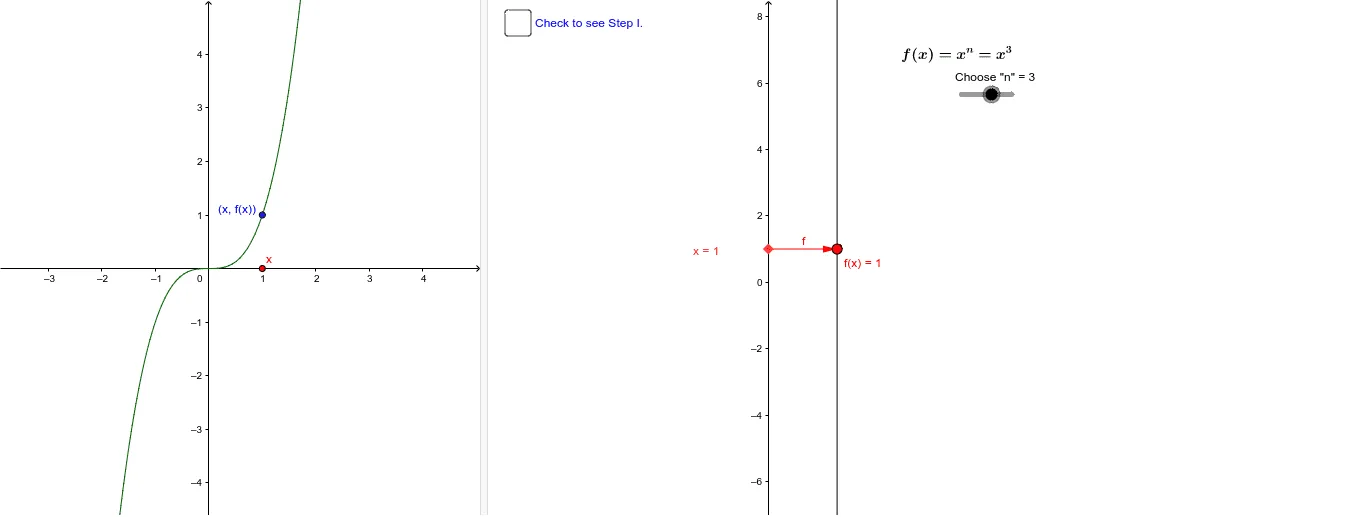
This example demonstrates the calculation and visualization of derivatives for power functions (n=1,2,3,...) using CCD.DPN method. It involves core mathematical concepts like derivatives, power functions, vectors, and coordinate geometry. Key GeoGebra commands used include Element, Point, Vector, Textfield, Segment, Line, Intersect, Simplify to construct function graphs, tangents, and vectors. Suitable for high school and above students to understand the geometric meaning of derivatives and function properties.
GeoGebra Commands & Parameters
Element(fnlist, fn) → f_1Point(yAxis) → AVector(A, B) → fTextfield(f_1) → inputBox1Vector(x_1, y_1) → vSegment(f_x, F) → cSegment(E, F) → dSegment(A, x_1) → eSegment(B, y_1) → gSegment(B, y_1) → ΔsegLine(x_1, y_1) → iLine(A, B) → kIntersect(i, k) → FocusTextfield(f_1) → inputBox2Line(f_x, E) → secantSimplify(Derivative[f_1]) → DfLine(f_x, Vector[(0, 0), (1, Df(y(A)))]) → tangentVector(B, C) → uVector(B, Est') → wSimplify(f_1(x + h) - f_1(x)) → diffcSimplify(diffc(x) / h) → diffq
AI Drawing Prompt Reference
Draw the graph of power functions (n=1,2,3,...) and their first derivatives. Start by taking a point A on the y-axis and constructing vector f through A and B. Input function f_1, construct vector v and point F. Then construct line segment c through A and F, and line segment d through E and F. Next, construct line segment e through A and x_1, line segment g through B and y_1, and line segment Δseg through B and y_1. Construct line i through x_1 and y_1, and line k through A and B, with their intersection as the focus. Input function f_1, construct secant line through f_x and E, and tangent line through f_x and F. Construct vector u through B and C, and vector w through B and Est'. Finally, simplify the expression f_1(x + h) - f_1(x) and its division by h, resulting in diffq.
The prompt above was compiled from the original drawing commands and is for reference only.