
Calculate Volume and Surface Area of a Pyramid
Loading the math board and drawing, please wait…
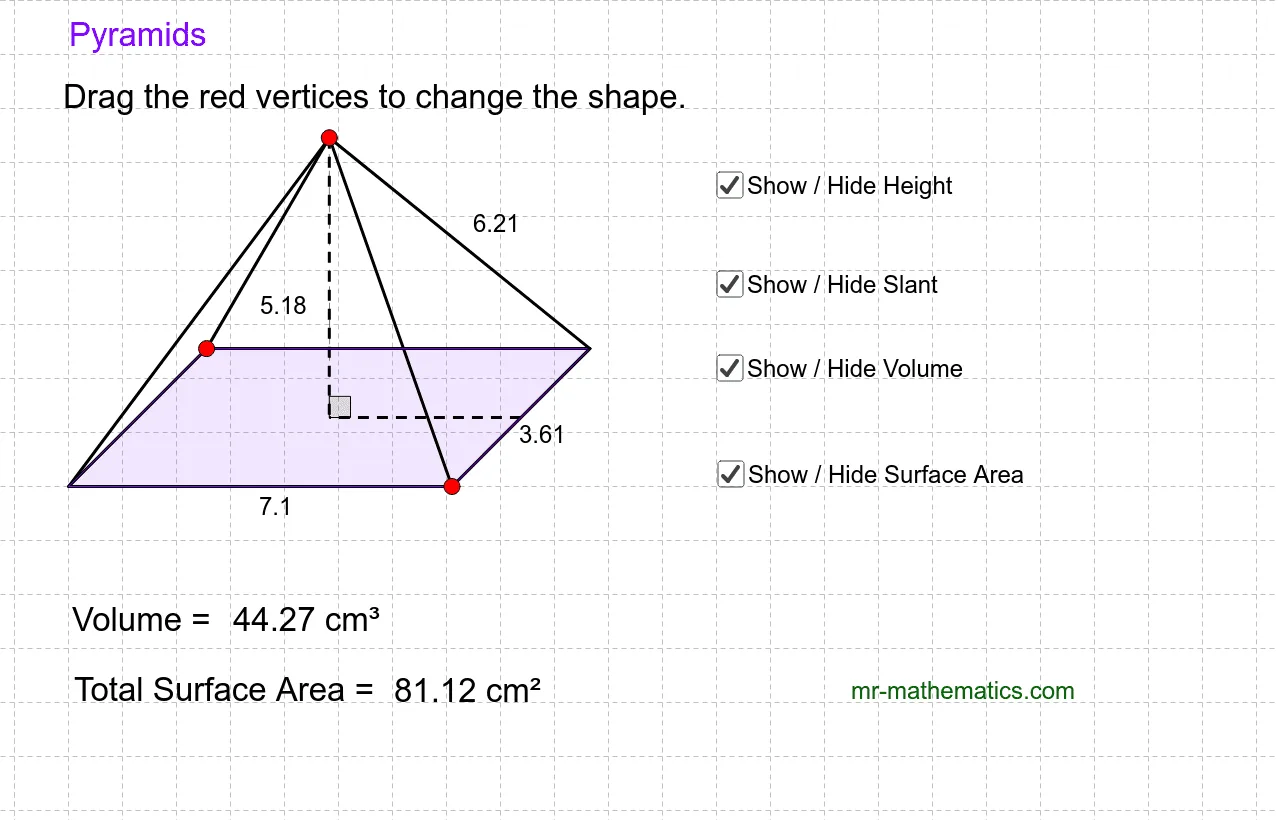
This example demonstrates how to calculate the volume and surface area of a pyramid by changing its dimensions. Key mathematical concepts include the formulas for volume and surface area in solid geometry. GeoGebra commands such as Line, Point, Intersect, Segment, Midpoint, Rotate, Angle, and Polygon are used for geometric construction. Suitable for high school math education or students learning solid geometry.
GeoGebra Commands & Parameters
Line(A, B) → aLine(A, C) → bPoint(b) → EPoint(a) → FLine(E, a) → cLine(F, b) → dIntersect(c, d) → GSegment(A, F) → eSegment(F, G) → fSegment(G, E) → gSegment(E, A) → hMidpoint(e) → HMidpoint(f) → ILine(I, e) → iLine(H, h) → jIntersect(i, j) → JRotate(I, 90*°, J) → I'Angle(I, J, I') → αLine(J, I') → kSegment(I, J) → lPoint(k) → KSegment(K, J) → mSegment(K, G) → nSegment(F, K) → pSegment(A, K) → qSegment(E, K) → rPolygon(A, F, G, E) → poly1, a_1, f_1, g_1, e_1Intersect(f, g) → LLine(A_1, B_1) → a_2Line(A_1, C_1) → b_1Point(b_1) → E_1Point(a_2) → F_1Line(E_1, a_2) → c_1Line(F_1, b_1) → d_1Intersect(c_1, d_1) → G_1Segment(A_1, F_1) → e_2Segment(F_1, G_1) → f_2Segment(G_1, E_1) → g_2Segment(E_1, A_1) → h_1Midpoint(e_2) → H_1Midpoint(f_2) → I_1Line(I_1, e_2) → i_1Line(H_1, h_1) → j_1Intersect(i_1, j_1) → J_1Rotate(I_1, 90*°, J_1) → I'_1Angle(I_1, J_1, I'_1) → α_1Line(J_1, I'_1) → k_1Segment(I_1, J_1) → l_1Point(k_1) → K_1Segment(K_1, J_1) → m_1Segment(K_1, G_1) → n_1Segment(F_1, K_1) → p_1Segment(A_1, K_1) → q_1Segment(E_1, K_1) → r_1Polygon(A_1, F_1, G_1, E_1) → poly1_1, a_3, f_3, g_3, e_3Line(A_2, B_2) → a_4Line(A_2, C_2) → b_2Point(b_2) → E_2Point(a_4) → F_2Line(E_2, a_4) → c_2Line(F_2, b_2) → d_2Intersect(c_2, d_2) → G_2Segment(A_2, F_2) → e_4Segment(F_2, G_2) → f_4Segment(G_2, E_2) → g_4Segment(E_2, A_2) → h_2Midpoint(e_4) → H_2Midpoint(f_4) → I_2Line(I_2, e_4) → i_2Line(H_2, h_2) → j_2Intersect(i_2, j_2) → J_2Rotate(I_2, 90*°, J_2) → I'_2Angle(I_2, J_2, I'_2) → α_2Line(J_2, I'_2) → k_2Segment(I_2, J_2) → l_2Point(k_2) → K_2Segment(K_2, J_2) → m_2Segment(K_2, G_2) → n_2Segment(F_2, K_2) → p_2Segment(A_2, K_2) → q_2Segment(E_2, K_2) → r_2Polygon(A_2, F_2, G_2, E_2) → poly1_2, a_5, f_5, g_5, e_5Segment(K, L) → s_1Point(l) → OSegment(K, O) → t_1
AI Drawing Prompt Reference
Draw a pyramid with its base and sides. Start by drawing two sides of the base, AB and AC. Then, take point E on AB and point F on AC. Draw perpendicular lines from E and F to the base, intersecting at point G. Connect points A and F, F and G, G and E, and E and A to form the pyramid's sides. Next, find the midpoints H and I of line segments AF and FG, respectively. Draw a line through I parallel to AF and another through H parallel to AE, intersecting at point J. Rotate point I 90 degrees to get point I'. Calculate the angle ∠IJI'. Finally, draw point K and connect it to the midpoints of the base sides to form the pyramid's sides.
The prompt above was compiled from the original drawing commands and is for reference only.