
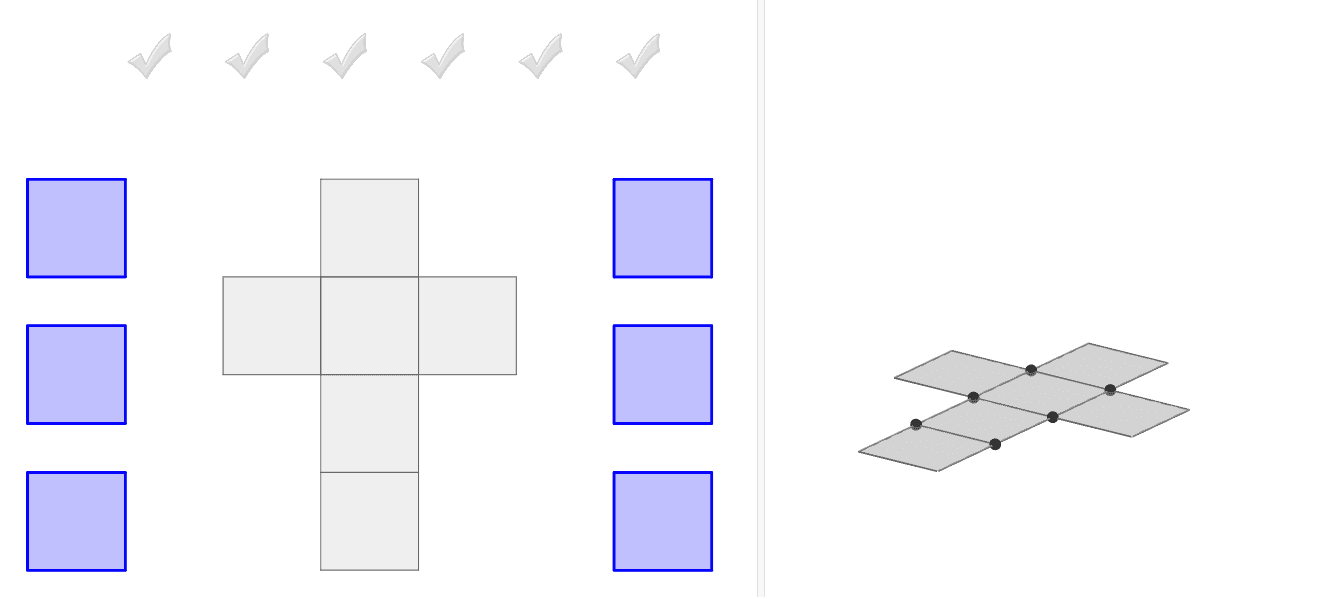
Build net of a cube
Loading the math board and drawing, please wait…
This example demonstrates how to construct the net of a cube by dragging square faces onto a grey net. It involves core mathematical concepts like solid geometry, polygon construction, and spatial visualization. Key GeoGebra commands and objects used include Polygon, Intersect, Point, Cube, Net, and Vector. Suitable for middle school students and teachers learning about 3D geometry and net construction.
GeoGebra Commands & Parameters
Polygon(M, N, C_1, N_2) → poly3, m_2, n, c_1, n_2Polygon(K_4, T_4, 4) → poly11, q, r, s, t, D_5, E_5Polygon(C_4, D_4, 4) → poly9, b, e, f_1, g_1, F_5, G_5Polygon(V_3, W_3, 4) → poly8, r_1, s_1, t_1, a_1, Z_3, A_4Polygon(Z_2, A_3, 4) → poly7, m_1, n_1, p_1, q_1, B_3, C_3Polygon(I_4, F_4, 4) → poly10, h_1, i_1, j_1, k_1, H_5, I_5Polygon(A_5, V_4, 4) → poly12, b_1, d_1, e_1, f_2, J_5, K_5Intersect(zAxis, xAxis) → APoint(xAxis) → BPolygon(A, B, 4, xOyPlane) → poly1, f, g, h, i, C, DCube(A, B, Point[Circle[B, Distance[A, B], Segment[A, B]]]) → a, E, face11, face12, edge20, edge21, edge22, edge23, edge24, edge25, edge26, edge27, F, edge28, edge29, edge30, edge31, G, H, B_4, face7, face8, face9, face10Point(Circle[B, Distance[A, B], Segment[A, B]]) → INet(a, c) → d, V_1, G_2, H_2, I_2, J_2, K_2, face1, face2, face4, face5, face3, W_1, face6, edge1, edge5, edge8, edge2, edge3, edge13, edge6, edge7, edge16, Z_1, edge9, edge10, edge17, edge11, edge12, edge18, edge4, edge15, edge19, edge14, A_2, B_2, C_2, D_2, E_2, F_2Net(a, o) → p, H_3, Q_3, R_3, S_3, T_3, U_3, face13, face14, face16, face17, face15, I_3, face18, edge39, edge43, edge46, edge40, edge41, edge51, edge44, edge45, edge54, J_3, edge47, edge48, edge55, edge49, edge50, edge56, edge42, edge53, edge57, edge52, K_3, L_3, M_3, N_3, O_3, P_3Polygon(J, K, L, M) → poly2, j, k, l, mPolygon(L, O_2, P_2, Q_2) → poly4, l_1, o_2, p_2, q_2Polygon(N, O_2, R_2, S_2) → poly5, n_3, o_1, r_2, s_2Polygon(L, O_2, N, M) → poly6, l_2, o_3, n_4, m_3Polygon(T_2, U_2, P_2, Q_2) → poly13, t_2, u_2, p_3, q_3Vector(B_5, C_5) → u