
Bubble Patterns and Transformations
Loading the math board and drawing, please wait…
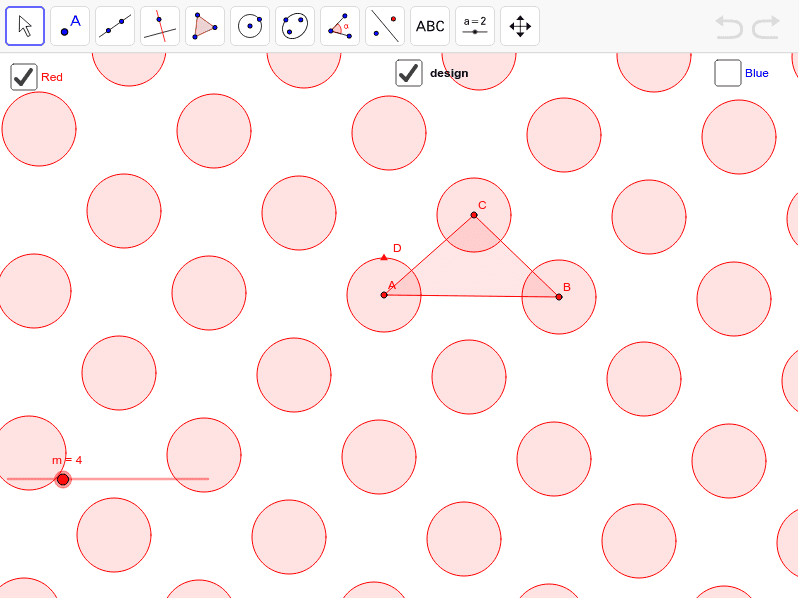
This example demonstrates the generation and interaction of random bubble patterns in 2D space based on transformations; involves core math concepts like translation, stochastic process, scatter plot, congruence; constructed using commands/objects such as Ray, Point, Circle, Polygon, Vector, Sequence in GeoGebra; suitable for high school mathematics teaching to understand the relationship between transformations, stochastic processes, and geometric figures.
GeoGebra Commands & Parameters
Ray(A, Vector[(0, 1)]) → dPoint(d) → DCircle(A, D) → cPolygon(A, B, C) → poly1, c_1, a, bVector(A, B) → uVector(A, C) → vPolygon(E, F, G) → poly2, g, e, fRay(E, Vector[(0, 1)]) → hPoint(h) → HCircle(E, H) → kVector(E, F) → wVector(E, G) → zSequence(Sequence[If[(i ≠ 0) ∨ (j ≠ 0), Translate[c, Vector[(i * u) + (j * v)]]], i, (-m), m], j, (-m), m) → list1Sequence(Sequence[If[(i ≠ 0) ∨ (j ≠ 0), Translate[k, Vector[(i * w) + (j * z)]]], i, (-n), n], j, (-n), n) → list2
AI Drawing Prompt Reference
Draw random bubble patterns in 2D space to demonstrate interaction based on transformations. Start by drawing a ray pointing upwards and a circle centered at the ray's starting point. Construct a polygon using two points and draw rays from its vertices, then circles centered at these rays. Finally, use random vectors to repeatedly translate the two circles, creating a stochastic distribution of bubbles that illustrates the relationship between transformations, random processes, and geometric figures.
The prompt above was compiled from the original drawing commands and is for reference only.