
Billiards: Vector and Geometric Transformations
Loading the math board and drawing, please wait…
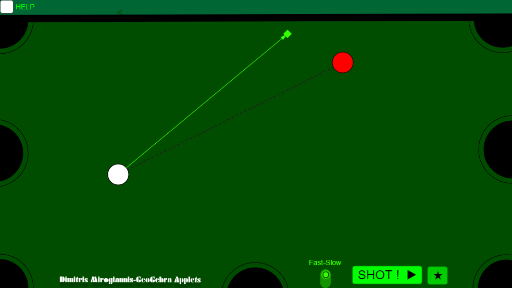
This example demonstrates vector and geometric transformations in billiards. By setting the positions, speeds, and angles of the balls, one can observe the trajectories and collision effects of the balls. The core mathematical concepts involved include vectors, angles, and geometric transformations. The construction uses commands and objects such as Vector, Polygon, PointIn, Segment, Angle, If, Translate, Circle, Line, OrthogonalLine, Intersect, Distance, Mirror in GeoGebra. It is suitable for high school students learning vectors, geometric transformations, and kinematics in physics.
GeoGebra Commands & Parameters
Vector(A, B) → uPolygon(Θ, Κ, Λ, Μ) → πολύγ1, θ, κ, λ, μPointIn(πολύγ1) → ESegment(C, E) → fAngle(E, C, B) → βIf(0 ≤ β < 2° ∨ 360° ≥ β > 358°, (f - 0.8) / abs(u), If[β ≥ 2° ∧ β ≤ 3° ∨ β ≥ 357° ∧ β ≤ 358°, (f - 0.75) / abs(u), (f - 0.7) / abs(u)]) → t1Translate(D, u) → D'Vector(D, D') → vSegment(DD, E) → hSegment(D, C) → gCircle(D, 0.4) → kCircle(E, 0.4) → pIf(h ≤ 0.8, j ≟ true, j ≟ false) → jjAngle(D, E, C) → αLine(C, D) → mLine(DD, E) → aOrthogonalLine(D', a) → bOrthogonalLine(D, a) → c_1Intersect(a, c_1) → ΑIntersect(a, b) → ΒVector(Α, Β) → wt1bOrthogonalLine(A, a) → dOrthogonalLine(B, a) → eIntersect(a, e) → FIntersect(a, d) → GVector(F, G) → wt1rLine(C, D') → iOrthogonalLine(E, i) → lIntersect(i, l) → HSegment(E, H) → nSegment(EE, TT) → rLine(DD, EE) → sDistance(TT, s) → aaaCircle(TT, 1.3) → qLine(Ε, Ζ) → a_1Intersect(s, a_1) → GGOrthogonalLine(GG, a_1) → b_1Mirror(s, b_1) → s'Segment(E, GG) → gggIf(y(GG) ≤ y(EE), t1 + ggg / abs(wt1b), 10) → t2Mirror(w, b_1) → w'Point(d_1) → ΗLine(Η, a_1) → e_1Point(d_1) → ΙCircle(II, 1.3) → f_1Circle(III, 1.3) → g_1Circle(IIII, 1.3) → h_1Line(C, B) → i_1Intersect(i_1, a_1) → KKOrthogonalLine(KK, a_1) → j_1Mirror(i_1, j_1) → k_1Mirror(uu, j_1) → uu'Segment(C, KK) → aaIf(β < 10° ∨ β > 350°, t1, t1') → t3Segment(KK, E) → LLCircle(KKK, abs(uu')) → p_1Intersect(p_1, k_1, 1) → ΝLine(KKK, E) → HH1OrthogonalLine(Ν, HH1) → m_1Intersect(HH1, m_1) → ΞVector(KKK, Ξ) → u_1OrthogonalLine(KKK, HH1) → n_1OrthogonalLine(Ν, n_1) → q_1Intersect(n_1, q_1) → ΟAngle(E, KK, KKK) → γIf(0 ≤ γ < 2° ∨ 360° ≥ γ > 358°, t3 + (LL - 0.8) / abs(uu'), If[γ ≥ 2° ∧ γ ≤ 3° ∨ γ ≥ 357° ∧ γ ≤ 358°, t3 + (LL - 0.7) / abs(uu'), t3 + (LL - 0.6) / abs(uu')]) → t4Angle(m_1, q_1) → δVector(KKK, Ο) → v_1Distance(E, k_1) → rrrIntersect(k_1, e_1) → ΠCircle(Π, 2) → r_1Intersect(r_1, k_1) → I, JVector(Π, I) → w_1Circle(IIIII, 1.3) → s_1Circle(IIIIII, 1.3) → t_1Circle(IIIIIII, 1.3) → c_2
AI Drawing Prompt Reference
Draw a billiard table as a polygon, marking the positions, speeds, and angles of the balls. Show the trajectories and collision effects of the balls as they move around the table, including reflections and changes in direction due to geometric transformations.
The prompt above was compiled from the original drawing commands and is for reference only.