
Baum Kite: Geometric Construction Merging Triangles, Vectors, and Conditional Pr
Loading the math board and drawing, please wait…
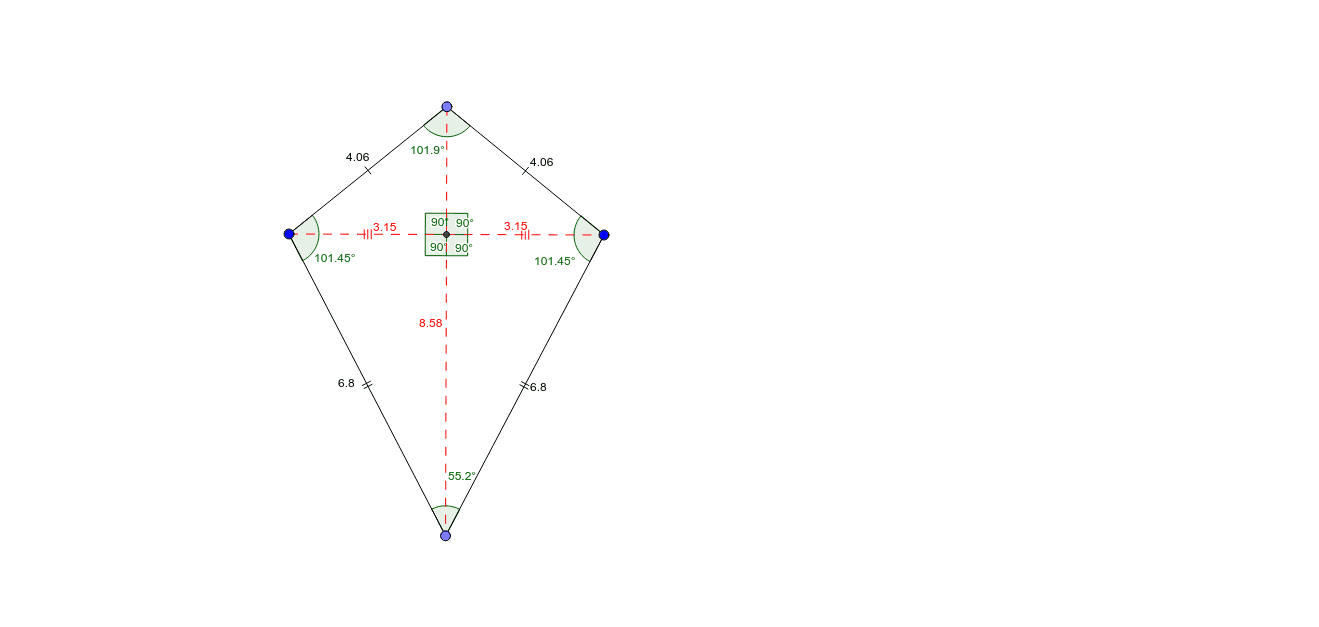
① This GeoGebra example, titled 'Baum Kite', constructs a kite-shaped geometric figure that integrates multiple mathematical concepts including fractions, 3D vectors, geometric distribution, scalene triangles, and conditional probability. ② The core mathematical ideas involve the symmetry properties of a kite, relationships between segments and angle bisectors, representation of vectors in three dimensions, probability models based on geometric distribution, classification of scalene triangles, and visualization of conditional probability. ③ Construction highlights: Based on the construction summary, the example uses GeoGebra commands such as Segment, LineBisector, Point, Angle, and Intersect, creating objects A, B, a, b, C, c, d, D, e, f, g, α, β, γ, δ, E, h, i, ε, ζ, η, θ, which together form the kite's framework and auxiliary lines. ④ Target audience and use: Suitable for high school to university-level mathematics education, this example serves as an interdisciplinary case combining geometric construction, vectors, and probability, ideal for teacher demonstrations or student-led exploration of the connections between geometry and probability.
GeoGebra Commands & Parameters
Segment(A, B) → aLineBisector(a) → bPoint(b) → CSegment(A, C) → cSegment(B, C) → dPoint(b) → DSegment(D, B) → eSegment(D, A) → fSegment(D, C) → gAngle(C, A, D) → αAngle(A, D, B) → βAngle(D, B, C) → γAngle(B, C, A) → δIntersect(a, g) → ESegment(A, E) → hSegment(E, B) → iAngle(D, E, A) → εAngle(B, E, D) → ζAngle(C, E, B) → ηAngle(A, E, C) → θ