
Base Angles of an Isosceles Triangle
Loading the math board and drawing, please wait…
In collections
Circle Geometry
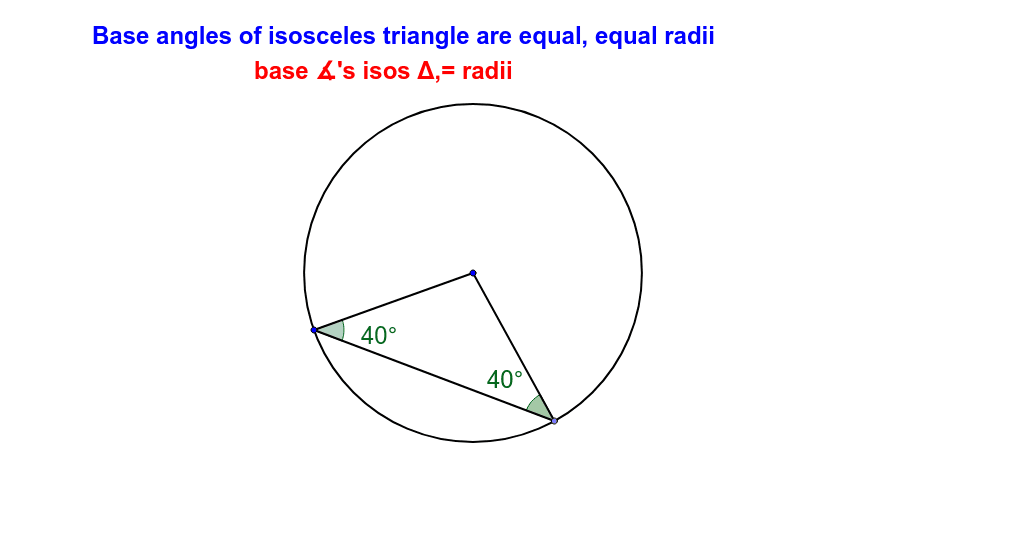
① This example dynamically demonstrates that the base angles of an isosceles triangle are always equal. ② The core mathematical concept is the isosceles triangle theorem: if two sides of a triangle are congruent, then the angles opposite those sides (the base angles) are congruent, involving angle measurement and the sum of interior angles. ③ Construction highlights: using GeoGebra commands such as Circle, Point, Segment, Angle, and Polygon to build the isosceles triangle, labeling the base angles α and β; dragging vertices allows real-time observation that the two angle measures remain equal. Objects include A_3, B_3, C, poly1, etc. ④ Suitable for middle school geometry teaching or self-study, serving as a visual proof and an interactive base for further geometric explorations.
GeoGebra Commands & Parameters
Circle(A_3, B_3) → cPoint(c) → CSegment(C, A_3) → aSegment(B_3, A_3) → bSegment(C, B_3) → dAngle(A_3, B_3, C) → αAngle(A_3, C, B_3) → βPolygon(E_1, H_1, G_1, F_1) → poly1, e_2, h_2, g_2, f_2Angle(G_1, F_1, E_1) → λAngle(E_1, H_1, G_1) → ξAngle(F_1, E_1, H_1) → οAngle(H_1, G_1, F_1) → ρ
AI Drawing Prompt Reference
Draw an isosceles triangle to dynamically demonstrate that its base angles are always equal. Start by drawing a segment as the base, then use its midpoint as a circle center to find the top vertex, connecting it to the base ends. Label the base angles as α and β, and observe that dragging the top vertex keeps them equal. Add a polygon, labeling its three interior angles λ, ξ, ο, and ρ for further geometric exploration.
The prompt above was compiled from the original drawing commands and is for reference only.