
Baravelle Pentagon Dodecahedron Basis
Loading the math board and drawing, please wait…
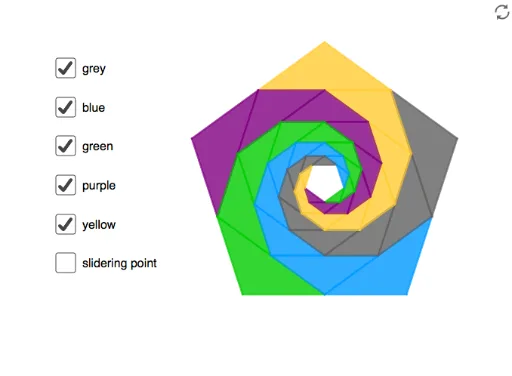
This example demonstrates the construction of a Baravelle pentagon with interactive elements, showcasing its role as a basis for a dodecahedron. Key mathematical concepts include polygon construction, similarity transformation, coordinate geometry, and geometric transformations. The construction emphasizes commands and objects like Intersect, Polygon, Point, Distance, and Circle in GeoGebra. Suitable for high school and above, focusing on solid geometry and geometric construction.
GeoGebra Commands & Parameters
Intersect(xAxis, yAxis) → APolygon(A, B, 5) → poly1, f, g, h, i, j, C, D, EPoint(f) → FDistance(A, F) → AFDistance(A, B) → ABCircle(B, AF) → cCircle(C, AF) → dCircle(D, AF) → eCircle(E, AF) → kIntersect(c, g, 1) → GIntersect(d, h, 1) → HIntersect(e, i, 1) → IIntersect(k, j, 1) → JPolygon(F, B, G) → t1, g_1, f_1, bPolygon(G, C, H) → t2, h_1, g_2, c_1Polygon(H, D, I) → t3, i_1, h_2, d_1Polygon(I, E, J) → t4, j_1, i_2, e_1Polygon(J, A, F) → t5, f_2, j_2, aCircle(J, (r * a)) → pIntersect(p, a, 1) → KCircle(I, (r * a)) → qCircle(H, (r * a)) → sCircle(G, (r * a)) → tCircle(F, (r * a)) → k_1Intersect(q, e_1, 1) → LIntersect(k_1, b, 1) → PIntersect(s, d_1, 1) → QIntersect(t, c_1, 1) → MPolygon(K, L, J) → t6, j_3, k_2, lPolygon(L, Q, I) → t7, i_3, l_1, q_1Polygon(Q, M, H) → t8, h_3, q_2, mPolygon(M, P, G) → t9, g_3, m_1, p_1Polygon(K, P, F) → t10, f_3, k_3, p_2Circle(K, (r * f_3)) → r_1Circle(L, (r * f_3)) → s_1Circle(Q, (r * f_3)) → t_1Circle(M, (r * f_3)) → c_2Circle(P, (r * f_3)) → d_2Intersect(r_1, f_3, 1) → NIntersect(s_1, j_3, 1) → OIntersect(t_1, i_3, 1) → RIntersect(c_2, h_3, 1) → SIntersect(d_2, g_3, 1) → TPolygon(N, K, O) → t11, o, n, k_4Polygon(O, L, R) → t12, r_2, o_1, l_2Polygon(R, Q, S) → t13, s_2, r_3, q_3Polygon(S, M, T) → t14, t_2, s_3, m_2Polygon(T, P, N) → t15, n_1, t_3, p_3Circle(N, (r * p_3)) → e_2Circle(O, (r * p_3)) → c_3Circle(R, (r * p_3)) → d_3Circle(S, (r * p_3)) → e_3Circle(T, (r * p_3)) → c_4Intersect(d_3, l_2, 1) → WIntersect(c_3, k_4, 1) → ZPolygon(O, Z, W) → t16, w, o_2, z_1Intersect(e_3, q_3, 1) → UPolygon(W, U, R) → t17, r_4, w_1, uIntersect(c_4, m_2, 1) → A_1Intersect(e_2, p_3, 1) → B_1Polygon(Z, B_1, N) → t18, n_2, z_2, b_1Polygon(U, S, A_1) → t19, a_1, u_1, s_4Polygon(A_1, B_1, T) → t20, t_4, a_2, b_2Circle(Z, (r * n_2)) → d_4Circle(W, (r * n_2)) → e_4Circle(U, (r * n_2)) → f_4Circle(A_1, (r * n_2)) → g_4Circle(B_1, (r * n_2)) → h_4Intersect(d_4, n_2, 1) → VIntersect(e_4, o_2, 1) → C_1Intersect(f_4, r_4, 1) → D_1Intersect(g_4, s_4, 1) → E_1Intersect(h_4, t_4) → F_1,Polygon(V, C_1, Z) → t21, z_3, v, c_5Polygon(C_1, D_1, W) → t22, w_2, c_6, d_5Polygon(D_1, U, E_1) → t23, e_5, d_6, u_2Polygon(E_1, A_1, F_1) → t24, f_5, e_6, a_3Polygon(V, F_1, B_1) → t25, b_3, v_1, f_6Circle(F_1, (r * a_3)) → p_4Circle(V, (r * a_3)) → q_4Circle(C_1, (r * a_3)) → g_5Circle(D_1, (r * a_3)) → h_5Circle(E_1, (r * a_3)) → k_5Intersect(q_4, b_3, 1) → G_1Intersect(g_5, z_3, 1) → H_1Intersect(h_5, w_2, 1) → I_1Intersect(k_5, u_2, 1) → J_1Intersect(p_4, a_3, 1) → K_1Polygon(G_1, H_1, V) → t26, v_2, g_6, h_6Polygon(H_1, I_1, C_1) → t27, c_7, h_7, i_4Polygon(I_1, D_1, J_1) → t28, j_4, i_5, d_7Polygon(J_1, K_1, E_1) → t29, e_7, j_5, k_6Polygon(K_1, G_1, F_1) → t30, f_7, k_7, g_7Circle(H_1, (r * v_2)) → p_5Circle(I_1, (r * v_2)) → q_5Circle(J_1, (r * v_2)) → r_5Circle(K_1, (r * v_2)) → s_5Circle(G_1, (r * v_2)) → t_5Intersect(p_5, v_2, 1) → L_1Intersect(q_5, c_7, 1) → M_1Intersect(r_5, d_7, 1) → N_1Intersect(s_5, e_7, 1) → O_1Intersect(t_5, f_7, 1) → P_1Polygon(L_1, P_1, G_1) → t31, g_8, l_3, p_6Polygon(H_1, L_1, M_1) → t32, m_3, h_8, l_4Polygon(M_1, I_1, N_1) → t33, n_3, m_4, i_6Polygon(N_1, J_1, O_1) → t34, o_3, n_4, j_6Polygon(O_1, K_1, P_1) → t35, p_7, o_4, k_8Circle(L_1, (r * g_8)) → q_6Circle(M_1, (r * g_8)) → r_6Circle(N_1, (r * g_8)) → s_6Circle(O_1, (r * g_8)) → t_6Circle(P_1, (r * g_8)) → q_7Intersect(r_6, h_8, 1) → Q_1Intersect(q_6, g_8, 1) → R_1Intersect(q_7, k_8, 1) → S_1Intersect(t_6, j_6, 1) → T_1Intersect(s_6, i_6, 1) → U_1Polygon(L_1, Q_1, R_1) → t36, r_7, l_5, q_8Polygon(Q_1, U_1, M_1) → t37, m_5, q_9, u_3Polygon(U_1, N_1, T_1) → t38, t_7, u_4, n_5Polygon(T_1, S_1, O_1) → t39, o_5, t_8, s_7Polygon(R_1, S_1, P_1) → t40, p_8, r_8, s_8Circle(Q_1, (r * l_5)) → c_8Intersect(c_8, l_5, 1) → V_1Circle(R_1, (r * l_5)) → d_8Circle(S_1, (r * l_5)) → e_8Circle(T_1, (r * l_5)) → f_8Circle(U_1, (r * l_5)) → c_9Intersect(d_8, p_8, 1) → W_1Intersect(e_8, o_5, 1) → Z_1Intersect(f_8, n_5, 1) → A_2Intersect(c_9, m_5, 1) → B_2Polygon(W_1, V_1, R_1) → t41, r_9, w_3, v_3Polygon(V_1, B_2, Q_1) → t42, q_{10}, v_4, b_4Polygon(B_2, U_1, A_2) → t43, a_4, b_5, u_5Polygon(A_2, T_1, Z_1) → t44, z_4, a_5, t_9Polygon(W_1, Z_1, S_1) → t45, s_9, w_4, z_5
AI Drawing Prompt Reference
Draw a Baravelle pentagon as the basis for a dodecahedron, starting with the intersection of coordinate axes, then construct a pentagon, draw circles centered at the pentagon's vertices, find their intersections to get new vertices, build several pentagons in sequence, and finally combine them to form a solid shape, showcasing the geometric relationship as the basis for a dodecahedron.
The prompt above was compiled from the original drawing commands and is for reference only.