
Ball in a Glass of Water
Loading the math board and drawing, please wait…
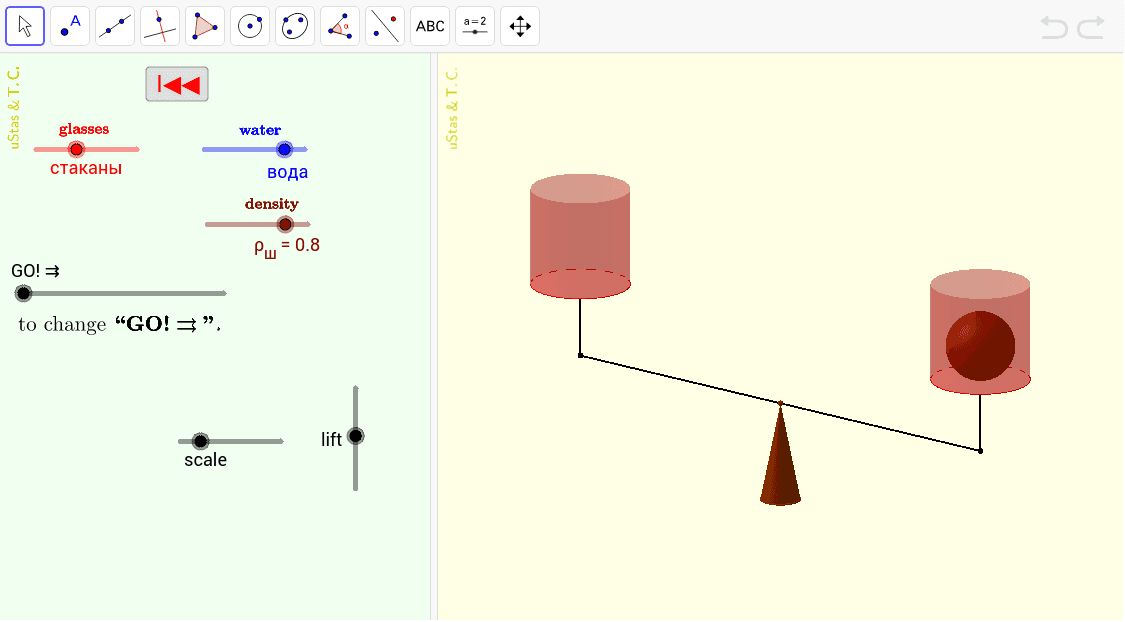
This example demonstrates the geometric phenomenon of a sphere partially submerged in water within a glass. It involves core mathematical concepts such as volume calculation, sphere surface area, percentages, and natural numbers. The construction utilizes GeoGebra commands and objects like RotateText, Circle, Sphere, Cylinder, and Intersect, as outlined in the summary. It is suitable for high school students studying solid geometry, volume calculations, and spatial reasoning.
GeoGebra Commands & Parameters
RotateText("uStas\;\&\,Т.С.", 90°) → надпись01Circle(Q - (0, 0, 2), 0.4, zAxis) → ϕCone(ϕ, 2) → d, c, a_1Segment(A, B) → plechySegment(A, A_1) → aSegment(B, B_1) → bCircle(A_1, m, zAxis) → ω_aCylinder(ω_a, (2 * m)) → φ_a, ω'_a, a_aCircle(B_1, m, zAxis) → ω_bCylinder(ω_b, (2 * m)) → φ_b, ω'_b, a_bSphere(A_1 + (0, 0, R), R) → ψ_aSphere(B_1 + (0, 0, R), R) → ψ_bLine(A_2 + (0, 0, (0.5 * p)), xAxis) → d_aLine(B_2 + (0, 0, (0.5 * p)), xAxis) → d_bParabola(F_a, d_a) → λ_aParabola(F_b, d_b) → λ_bIntersect(Line[A_1 + (0, 0, h), xAxis], λ_a, 2) → G_aIntersect(Line[B_1 + (0, 0, h), xAxis], λ_b, 1) → G_bCurveCartesian(x(A_2) - i, 0, z(A_2) - (0.5 * i^(2) / p), i, 0, ii) → θ_aCurveCartesian(x(B_2) + i, 0, z(B_2) - (0.5 * i^(2) / p), i, 0, ii) → θ_bCylinder(ω_a, h) → ϕ_a, ω''_a, iIntersect(f, xAxis, 2) → FIntersectPath(z = z(B_1) + h_3, ψ_b) → θPoint(θ, 0.5) → USurface(x(A_1) + ((R * sin(i)) * sin(j)), y(A_1) + ((R * sin(i)) * cos(j)), z(A_1) + R + (R * cos(i)), i, α_1, (2 * π) - α_1, j, 0, 6.2831853072) → ψ'_aSurface(x(A_1) + ((R * sin(i)) * sin(j)), y(A_1) + ((R * sin(i)) * cos(j)), z(A_1) + R + (R * cos(i)), i, 1.5707963267948966, 4.71238898038469, j, 0, 3.141592653589793) → ψ''_aSurface(x(A_1) + ((R * sin(i)) * sin(j)), y(A_1) + ((R * sin(i)) * cos(j)), z(A_1) + R + (R * cos(i)), i, π - α_1, π + α_1, j, 0, 6.2831853072) → ψ'''_aCylinder(ω''_a, h') → ϕ'_a, ω'''_a, gCylinder(ω_b, (h' * h_3 / h_4)) → ϕ_b, ω''_b, jSphere(B_3, R) → ψ'_bTranslate(θ, Vector[(0, 0, h_5 + (1.5 * p))]) → θ'Cylinder(ω_b, (h' * h_3 / h_4) + h_5 + (1.5 * p)) → ϕ'_b, e, kTranslate(U, Vector[B_1, A_1]) → U_aCircle(A_1 + (0, 0, z(U_a) - z(A_1)), Radius[θ], zAxis) → θa