
Balancing Population
Loading the math board and drawing, please wait…
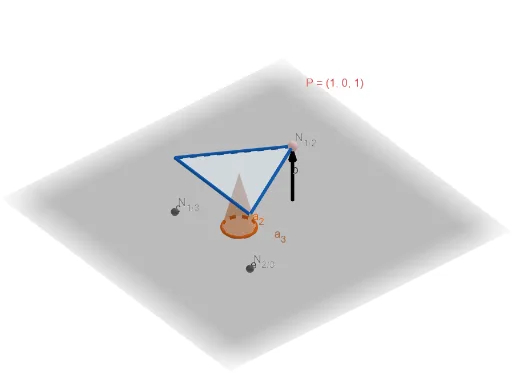
This example demonstrates the process of achieving population equilibrium in a cake-slicing game. It involves optimization problems and properties of rectangles. Using GeoGebra commands such as Vector, Intersect, Point, etc., different shapes of polygons can be constructed and their properties explored. Suitable for high school mathematics education and learning.
GeoGebra Commands & Parameters
Vector((-1 / 2, ((-sqrt(3))) / 2, 0)) → uVector((-1 / 2, sqrt(3) / 2, 0)) → wVector((1, 0, 0)) → vVector((0, 0, h)) → rIntersect(yAxis, zAxis) → BPoint((0, 0, 0), q_{1}) → T_{1}Point((0, 0, 0), q_{2}) → T_{2}Point((0, 0, 0), q_{3}) → T_{3}Polygon(T_{2}, T_{1}, T_{3}) → t1, t_{3}, t_{2}, t_{1}Point((0, 0, 0), d) → ACone(B, A, 0.25) → a, a_2, a_3PointIn(t1) → PVector(P) → SPoint((0, 0), n_{1}) → N_{1/2}Point((0, 0), n_{2}) → N_{1/3}Point((0, 0), n_{3}) → N_{2/3}Polygon(N_{1/2}, N_{1/3}, N_{2/3}) → t2, f, g, iVector(Point[(0, 0), v], N_{1/2}) → bVector(Point[(0, 0), w], N_{1/3}) → cVector(Point[(0, 0, 0), u], N_{2/3}) → e