
ATP Verification: Obtaining a Sufficient Condition to Avoid Degeneracy
Loading the math board and drawing, please wait…
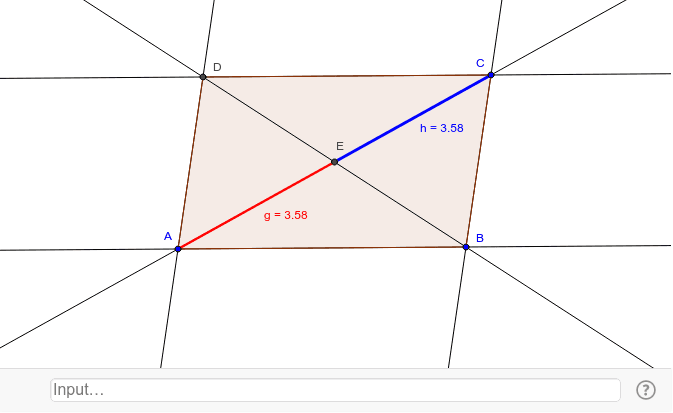
This GeoGebra example demonstrates automated theorem proving (ATP) to verify a geometric statement and derive a sufficient condition that prevents degeneracy cases. The core mathematical concepts involve parallelograms, straight lines, limits, definite integrals, equilateral triangles, and Poisson distributions, but the focus is on using geometric constraints and algebraic reasoning to ensure non-degenerate configurations. The construction uses commands such as Line, Intersect, Segment, and Polygon to create objects like points A and B, line a, segments b, c, d, and polygon poligon1, then verifies relationships among them. This example is suitable for high school or undergraduate mathematics education, illustrating how to combine dynamic geometry software with formal verification tools to help students understand rigorous proofs and condition analysis in geometry.
GeoGebra Commands & Parameters
Line(A, B) → aLine(C, B) → bLine(C, a) → cLine(A, b) → dIntersect(c, d) → DLine(D, B) → eLine(A, C) → fIntersect(e, f) → ESegment(A, E) → gSegment(E, C) → hPolygon(A, B, C, D) → poligon1, a_1, b_1, c_1, d_1
AI Drawing Prompt Reference
Draw a quadrilateral with four vertices connected in order. Start by placing two adjacent vertices and drawing a line through them. From a third vertex, draw two lines: one passing through the second vertex, and another parallel to the first line. Find the intersection of these two new lines to get the fourth vertex. Then connect the fourth vertex to the second vertex, and connect the first vertex to the third vertex; these two lines intersect at a point. Finally, draw segments from the first vertex to that intersection point and from that point to the third vertex, and connect all four vertices to form a closed polygon.
The prompt above was compiled from the original drawing commands and is for reference only.