
Area of Parallelogram by Peter Johnston
Loading the math board and drawing, please wait…
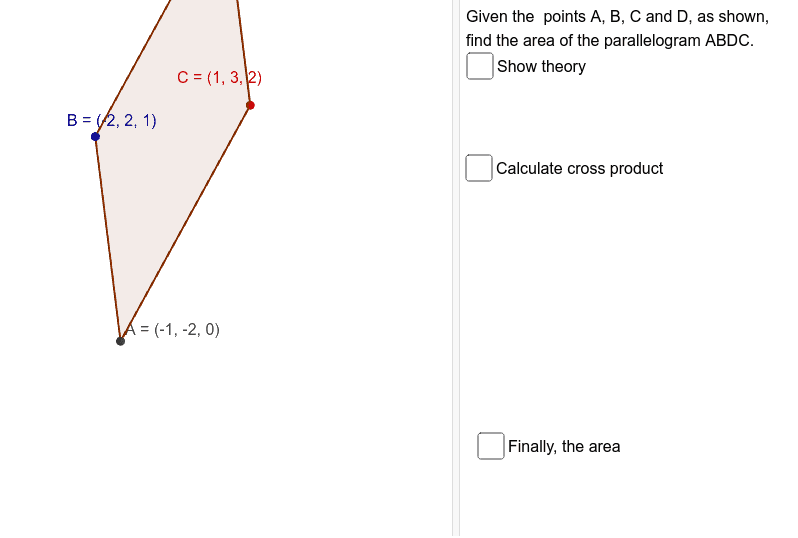
This example demonstrates how to calculate the area of a parallelogram using vectors and coordinate geometry. Key mathematical concepts include the cross product of vectors and the construction of polygons. Using GeoGebra commands such as Vector, Polygon, and crossProduct, the construction process is visually illustrated. Suitable for students at the middle school level and above, focusing on geometry and vector studies.
GeoGebra Commands & Parameters
Vector(A, B) → uVector(A, C) → vTableText({{LaTeX["\hat{i}"], LaTeX["\hat{j}"], LaTeX["\hat{k}"]}, {LaTeX[(("\textcolor{#000099}{" * x(u)) * "}")], LaTeX[(("\textcolor{#000099}{" * y(u)) * "}")], LaTeX[(("\textcolor{#000099}{" * z(u)) * "}")]}, {LaTeX[(("\textcolor{#CC0000}{" * x(v)) * "}")], LaTeX[(("\textcolor{#CC0000}{" * y(v)) * "}")], LaTeX[(("\textcolor{#CC0000}{" * z(v)) * "}")]}}, "||c") → text2Polygon(A, B, D, C) → poly1, f, g, h, iLaTeX($1) → text5LaTeX((((((((((((((((((((((((((((((((("\textcolor{#000099}{\vec{AB}}\times\textcolor{#CC0000}{\vec{AC}}\cr=\text{ }" * text2) * " \cr=\hat{i}[(\textcolor{#000099}{") * y(u)) * "})(\textcolor{#CC0000}{") * z(v)) * "})-(\textcolor{#000099}{") * z(u)) * "})(\textcolor{#CC0000}{") * y(v)) * "})] \cr\text{ }-\hat{j}[(\textcolor{#000099}{") * x(u)) * "})(\textcolor{#CC0000}{") * z(v)) * "})-(\textcolor{#000099}{") * z(u)) * "})(\textcolor{#CC0000}{") * x(v)) * "})] \cr\text{ }+\hat{k}[(\textcolor{#000099}{") * x(u)) * "})(\textcolor{#CC0000}{") * y(v)) * "})-(\textcolor{#000099}{") * y(u)) * "})(\textcolor{#CC0000}{") * x(v)) * "})] \cr=(") * x(crossProduct)) * ",") * y(crossProduct)) * ",") * z(crossProduct)) * ")")) → text3