
Area of Parallelogram by Jordan Varney
Loading the math board and drawing, please wait…
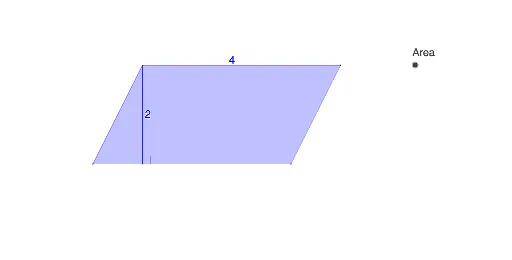
This example demonstrates how to calculate the area of a parallelogram using geometric construction. Key mathematical concepts include the properties of parallelograms and the area formula. Using GeoGebra commands such as Polygon, Vector, and Translate, the construction process is dynamically shown. Suitable for middle school and above students learning geometry and area calculation.
GeoGebra Commands & Parameters
Polygon(A, D, C, E) → poly2, a_1, d, a, hPoint(Circle[A, Area]) → FVector(A, F) → uTranslate(A, u) → A'Translate(E, u) → E'Translate(B, u) → B'Polygon(A', E', B') → poly1', b', a', e'Angle(C, E, A) → αSegment(A, B) → a_2Segment(B, E) → bPoint(a) → GAngle(A, G, B) → β
AI Drawing Prompt Reference
Draw a parallelogram and demonstrate how to calculate its area using geometric construction. First, create a parallelogram, then find the midpoint of one side and draw a perpendicular line. Next, use vector translation to construct a smaller parallelogram that has the same area as the original. Finally, label key angles and side lengths to show the area calculation process.
The prompt above was compiled from the original drawing commands and is for reference only.