
Area of a Trapezoid: Dynamic Construction and Formula Derivation
Loading the math board and drawing, please wait…
In collections
geometriadinamica.es
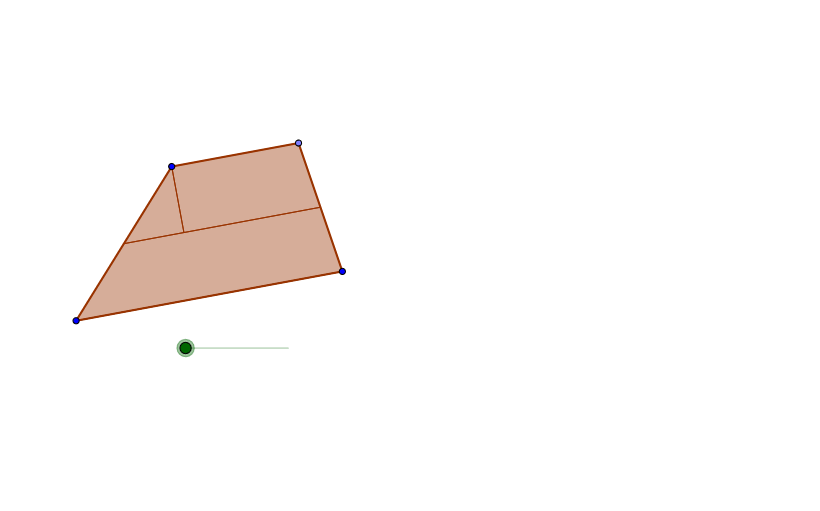
This GeoGebra example provides an interactive geometric construction that dynamically demonstrates the derivation of the trapezoid area formula. The core mathematical concept is the area of a trapezoid in plane geometry, involving bases, height, median, and the relationship between the trapezoid and triangles or parallelograms. The construction uses commands such as Segment, Line, Point, Midpoint, OrthogonalLine, Intersect, Polygon, and Rotate to draw the trapezoid, construct its median and height, and then split and rotate parts of the figure to rearrange it into a known shape (like a parallelogram or rectangle). This visual rearrangement clearly shows that the area equals (sum of bases) × height ÷ 2. Suitable for middle school geometry lessons, this example helps students understand the origin of the formula, and can be used by teachers for classroom demonstrations or by students for independent exploration, enhancing geometric intuition and deductive reasoning.
GeoGebra Commands & Parameters
Segment(A, B) → aLine(C, a) → bPoint(b) → DMidpoint(C, A) → ELine(E, a) → cOrthogonalLine(C, c) → dMidpoint(D, B) → FOrthogonalLine(D, c) → eIntersect(d, c) → GPolygon(E, G, C) → P, c_1, e_1, gRotate(E, j, E) → E'Rotate(G, j, E) → G'Rotate(C, j, E) → C'Polygon(E', G', C') → P', c', e', g'Polygon(C, G, F, D) → Q, c_2, g_1, f, d_1Rotate(C, h, F) → C'_1Rotate(G, h, F) → G'_1Rotate(F, h, F) → F'Rotate(D, h, F) → D'Polygon(C'_1, G'_1, F', D') → Q', c'_1, g'_1, f', d'Polygon(A, E, F, B) → R, a_1, e_2, f_1, b_1Polygon(A, C, D, B) → S, a_2, c_3, d_2, b_2
AI Drawing Prompt Reference
Draw a trapezoid ABCD with A and B as the endpoints of one base and C and D as the endpoints of the other base. First, draw line segments AB and CD. Then, construct the midpoints E and F of AB and CD, respectively, and draw lines through E and F parallel to AB and CD, which intersect CD and AB at points G and H. Next, divide the trapezoid into two triangles and a parallelogram, and rotate these parts to rearrange them into a parallelogram, visually demonstrating the area formula for a trapezoid: (sum of the lengths of the bases) × height ÷ 2.
The prompt above was compiled from the original drawing commands and is for reference only.