
Area of a Rhombus: Geometric Construction and Formula by GeoGebra Materials Team
Loading the math board and drawing, please wait…
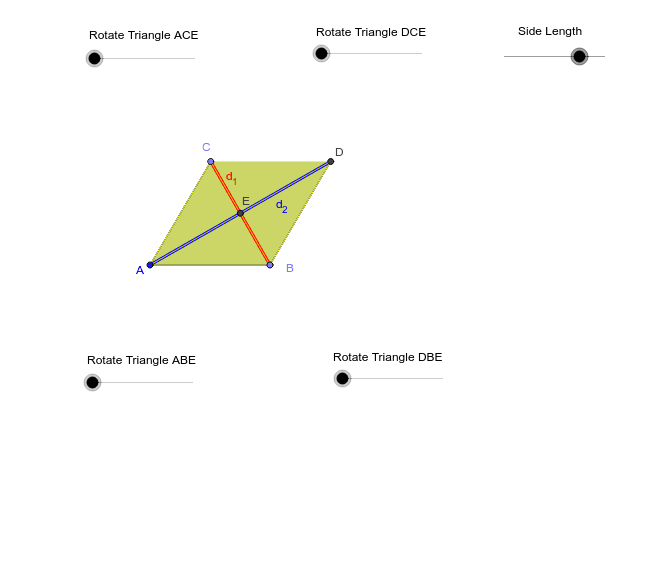
This GeoGebra example dynamically demonstrates the area of a rhombus and its relationship with the diagonals. The core mathematical concept is that the area of a rhombus equals half the product of its two diagonals, while also involving polygon properties, symmetry, and rotation. The construction uses commands such as Point, Segment, Circle, Line, Intersect, Polygon, Midpoint, Mirror, and Rotate to build the rhombus and auxiliary lines. Multiple named objects (a, A, B, b, c, C, d, e, f, D, g, h, m, n, E, P, etc.) are employed to ensure precise geometric relations. This example is suitable for middle and high school geometry classes, helping students understand the derivation of the rhombus area formula, explore diagonal properties, and develop spatial reasoning and logical deduction skills.
GeoGebra Commands & Parameters
Point(Circle[A, a]) → BSegment(A, B) → bCircle(A, a) → cPoint(c) → CSegment(A, C) → dCircle(C, a) → eLine(C, b) → fIntersect(e, f, 2) → DSegment(C, D) → gSegment(D, B) → hSegment(A, D) → mSegment(C, B) → nIntersect(m, n) → EPolygon(C, E, D) → P, d_1, c_1, e_1Polygon(C, E, A) → Q, a_1, c_2, e_2Polygon(A, E, B) → R, b_1, a_2, e_3Polygon(B, D, E) → S, e_4, b_2, d_2Midpoint(D, C) → FMidpoint(D, B) → GMidpoint(A, B) → HMidpoint(A, C) → IMirror(C, I) → C'Mirror(E, I) → E'Mirror(A, I) → A'Mirror(C, F) → C'_1Mirror(E, F) → E'_1Mirror(D, F) → D'Mirror(B, G) → B'Mirror(D, G) → D'_1Mirror(E, G) → E'_2Mirror(A, H) → A'_1Mirror(E, H) → E'_3Mirror(B, H) → B'_1Rotate(C, α, I) → C'_2Rotate(E, α, I) → E'_4Rotate(A, α, I) → A'_2Polygon(C'_2, E'_4, A'_2) → Q', a'_2, c'_2, e'_4Rotate(C, -β, F) → C'_3Rotate(E, -β, F) → E'_5Rotate(D, -β, F) → D'_2Polygon(C'_3, E'_5, D'_2) → P', d'_2, c'_3, e'_5Rotate(A, γ, H) → A'_3Rotate(E, γ, H) → E'_6Rotate(B, γ, H) → B'_2Polygon(A'_3, E'_6, B'_2) → R', b'_2, a'_3, e'_6Rotate(B, -δ, G) → B'_3Rotate(D, -δ, G) → D'_3Rotate(E, -δ, G) → E'_7Polygon(B'_3, D'_3, E'_7) → S', e'_7, b'_3, d'_3